How BJP, Modi Government Are Planning to Counter Delhi Protests
By Administrator | National | 30-Oct-2026 12:26:53
News Story
The political atmosphere in the national capital has intensified as opposition parties continue to organise protests against the Election Commission of India (ECI) over the Special Intensive Revision (SIR) of electoral rolls. The protests have created a major political challenge for the Bharatiya Janata Party (BJP) and the Narendra Modi-led government, prompting the ruling party to prepare a multi-layered strategy to respond to the opposition's campaign.
The controversy mainly revolves around allegations of irregularities in voter list revisions and demands for accountability from Chief Election Commissioner (CEC) Gyanesh Kumar. Opposition parties, including the Congress-led INDIA bloc and youth groups such as the Cockroach Janta Party (CJP), have raised concerns about voter deletions and the transparency of the electoral process.
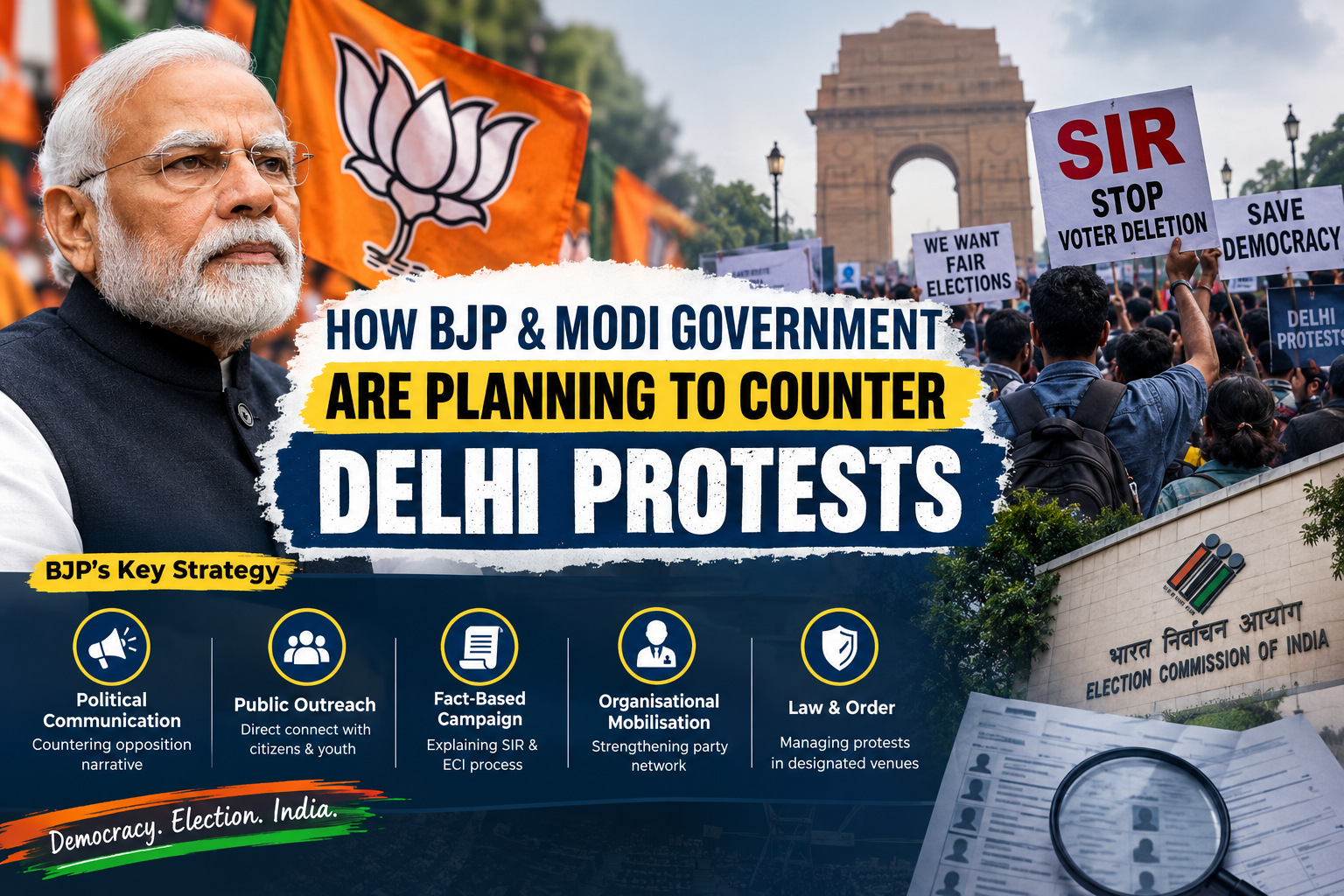
In response, the BJP is focusing on political communication, public outreach, organisational mobilisation and an explanation of the government's position on the SIR exercise. The party is also preparing to challenge opposition allegations while maintaining that electoral procedures must follow established laws and constitutional provisions.
Recent developments indicate that the BJP is not relying on a single approach. Instead, the party is combining political messaging, engagement with young protesters and organisational planning to counter the growing opposition movement.
Why Are Protests Taking Place in Delhi?
The current political confrontation is largely connected to the Special Intensive Revision (SIR) of electoral rolls conducted by the Election Commission.
SIR is an exercise intended to review and update electoral rolls to improve their accuracy. However, opposition parties have alleged that the process has resulted in large-scale voter deletions and could affect the voting rights of eligible citizens.
The Congress and other INDIA bloc parties have questioned the transparency of the exercise and demanded greater accountability from the Election Commission.
The opposition has also raised concerns about the functioning of the constitutional institution and demanded action against Chief Election Commissioner Gyanesh Kumar.
These issues have become central to the protests taking place in Delhi, with political parties attempting to bring public attention to electoral transparency, democratic accountability and voting rights.
The BJP, on the other hand, has defended the electoral process and is seeking to counter the opposition's allegations through political campaigns and public communication.
BJP's Multi-Layered Strategy to Counter Opposition Protests
The BJP appears to be following a multi-pronged strategy to respond to the protests. Rather than depending only on political statements, the party is focusing on several areas, including public outreach, information campaigns and organisational preparedness.
The strategy includes presenting its position on the SIR exercise, responding to allegations made by opposition leaders and communicating its message directly to the public.
According to reports, the BJP has also prepared a fact sheet covering issues related to the Election Commission, disagreements among election commissioners and changes in electoral rolls.
The purpose of this approach is to provide the party's version of events and challenge the opposition's claims with information and political arguments.
The BJP is also keeping its criticism focused on Congress leaders, particularly Rahul Gandhi, and the Aam Aadmi Party (AAP), while portraying the opposition's protest strategy as politically motivated.
Modi Government's Focus on Public Outreach
One of the important aspects of the government's response is its emphasis on public outreach.
The BJP leadership appears interested in communicating directly with different sections of society, particularly young people and students who have participated in the protests.
The government has previously engaged with youth groups during demonstrations related to the NEET paper leak issue. During those discussions, Union Ministers J P Nadda and Jitendra Singh held meetings with representatives of the Cockroach Janta Party.
Those discussions helped bring an end to that particular protest movement.
The experience is relevant to the current situation because the BJP may once again consider dialogue and engagement as ways to address concerns raised by young protesters.
However, the current SIR controversy involves wider questions about electoral institutions and voter rights, making the political situation more complex.
BJP's Political Counterattack Against Congress and Rahul Gandhi
Another major part of the BJP's response is its political counterattack against opposition leaders.
The BJP has criticised Congress and Rahul Gandhi over their statements regarding the Election Commission and electoral transparency. Party leaders have also questioned the opposition's approach to raising concerns about democratic institutions.
The ruling party is attempting to shift the political discussion towards its own arguments about electoral procedures, national security and alleged irregularities.
BJP leaders have also used public programmes and political campaigns to communicate their position.
On October 28, BJP president Nitin Nabin addressed a 'Save Democracy, Remove Anarchy' padyatra in Chandni Chowk, where he defended Prime Minister Narendra Modi's leadership and criticised Rahul Gandhi.
This indicates that the BJP is also using political mobilisation to challenge the opposition's narrative on democracy.
New Protest Venues and Delhi's Law-and-Order Strategy
Managing public demonstrations in the national capital is another important part of the government's approach.
Following the disruption caused by earlier demonstrations, authorities introduced changes to designated protest locations in Delhi.
Jantar Mantar was denotified as a designated protest site, while Ramlila Maidan, Burari Ground and CBD Ground were identified as alternative locations for demonstrations.
The stated objective was to manage public protests while reducing inconvenience to residents, commuters and businesses in central Delhi.
The BJP has presented the availability of designated protest venues as evidence that people can continue expressing their views within the established legal framework.
At the same time, Delhi Police and other authorities remain responsible for maintaining public order and implementing applicable restrictions.
The balance between citizens' right to peaceful protest and the need to maintain law and order remains an important issue in the ongoing political debate.
Election Commission's Response to the SIR Controversy
The Election Commission has also taken steps to address concerns raised during the SIR exercise.
According to information reported by The Indian Express on October 13, the draft electoral roll in Delhi had seen approximately 47.7 lakh entries removed from a total of around 1.45 crore voters.
The Delhi Chief Electoral Officer stated that around 33 lakh entries were under logical discrepancy or unmapped categories and that approximately 20 lakh cases had been resolved at that point.
The Election Commission also encouraged citizens facing difficulties to contact local Booth Level Officers (BLOs) and other election officials.
These developments are important because the controversy is not limited to political disagreements. It also involves the practical question of ensuring that eligible citizens remain registered and can exercise their voting rights.
For official information about voter registration, electoral rolls and related procedures, citizens can visit the Election Commission of India official website.
BJP Reviews Its Campaign Ahead of November 1 Rally
The BJP has continued reviewing its organisational preparations as opposition parties plan further demonstrations.
On October 29, the party scheduled a meeting at its New Delhi headquarters to assess the progress of its SIR campaign and discuss its response to opposition protests.
Union Ministers Shivraj Singh Chouhan and Ashwini Vaishnaw, along with other senior party leaders, were expected to participate in the meeting.
The discussion was expected to focus on campaign progress, organisational preparedness and ways to communicate the BJP's position on electoral roll revisions.
Meanwhile, the INDIA bloc has planned a public programme targeting Chief Election Commissioner Gyanesh Kumar on October 30.
Congress has also announced a 'Dilli Chalo' march and a public gathering at Ramlila Maidan on November 1.
The rally is expected to bring opposition leaders and supporters together to raise concerns about the SIR exercise and the functioning of the Election Commission.
These developments suggest that the political confrontation may continue in the coming days.
What Could Happen Next in Delhi Politics?
The coming weeks could prove important for both the BJP and the opposition.
For the BJP, the immediate challenge will be to explain its position on the SIR exercise, respond to allegations and prevent the opposition from dominating the political discussion.
The party may continue using public meetings, political campaigns and direct communication to present its arguments.
For opposition parties, the challenge will be to maintain unity and keep public attention focused on electoral transparency and voter rights.
The Election Commission's response to complaints, the progress of voter list corrections and any further judicial developments could also influence the direction of the controversy.
Ultimately, the issue will be judged not only through political statements but also through the transparency of electoral procedures and the confidence citizens have in democratic institutions.
Frequently Asked Questions (FAQs)
Q1. Why are protests taking place in Delhi?
The protests are mainly related to the Special Intensive Revision (SIR) of electoral rolls. Opposition parties have raised concerns about voter deletions and demanded accountability from the Election Commission.
Q2. What is the BJP's strategy to counter Delhi protests?
The BJP is focusing on public outreach, political campaigns, fact-based communication, youth engagement and organisational mobilisation to respond to opposition protests.
Q3. What is the SIR controversy?
The Special Intensive Revision is an exercise conducted by the Election Commission to review and update electoral rolls. Opposition parties have questioned the process and raised concerns about the removal of eligible voters.
Q4. Who is leading the opposition protests?
The Congress-led INDIA bloc and youth groups, including the Cockroach Janta Party, have been involved in protests against Chief Election Commissioner Gyanesh Kumar.
Q5. When is the next major opposition rally in Delhi?
Congress has announced a 'Dilli Chalo' march and public gathering at Ramlila Maidan on November 1, 2026.
Conclusion
The ongoing Delhi protests have become an important political challenge for the BJP and the Narendra Modi government. With opposition parties continuing to question the SIR exercise and the functioning of the Election Commission, the ruling party is focusing on public outreach, political communication and organisational preparations.
The BJP's response combines dialogue with young protesters, criticism of opposition leaders and efforts to explain its position on electoral reforms.
The coming days will be significant in determining how the political situation develops. Ultimately, transparency in electoral processes, protection of voting rights and public confidence in democratic institutions will remain central to the debate.
Disclaimer: This article is based on publicly available news reports and political developments as of October 30, 2026. Allegations made by political parties are presented as claims and should not be treated as independently established facts.