Fundamental Human Rights Everyone Should Know
By | Law | 10-Aug-2026 12:25:38
News Story
Human rights are the basic rights and freedoms that belong to every person simply because they are human. They are essential for living with dignity, equality, freedom and security. Human rights apply to everyone, regardless of nationality, gender, religion, language, social background or other personal circumstances.
Understanding human rights is important not only for lawyers and policymakers but for everyone. Awareness helps people recognise discrimination and exploitation, understand their freedoms and respect the rights and dignity of others.
What Are Fundamental Human Rights?
Human rights are broader principles recognised through international and national legal frameworks. They include rights related to life, liberty, equality, education, freedom of expression, work and protection from discrimination.
In India, several important rights are constitutionally protected as Fundamental Rights under Part III of the Constitution of India. While the terms human rights and Fundamental Rights are sometimes used interchangeably in everyday discussions, they are not exactly the same. Fundamental Rights specifically refer to the rights guaranteed by the Indian Constitution.
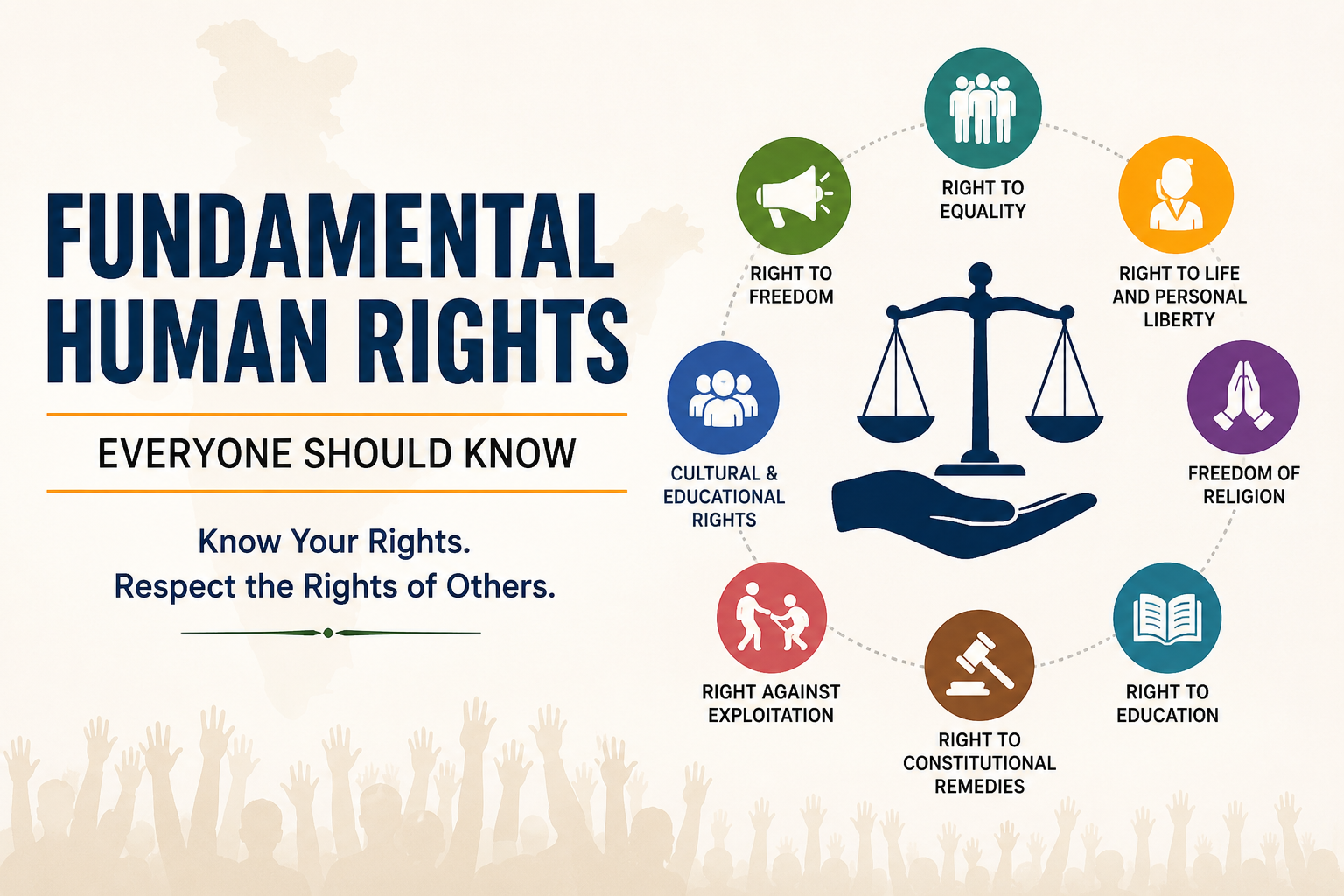
Right to Equality
The Right to Equality is an important constitutional protection. It provides for equality before the law and equal protection of laws. The Constitution also prohibits discrimination on certain specified grounds and provides safeguards against practices such as untouchability.
Equality is an important foundation of a fair society because people should not be denied legal protection or opportunities through unlawful discrimination.
Right to Freedom
The Right to Freedom protects several important freedoms, subject to reasonable restrictions prescribed by law.
These include freedom of speech and expression, peaceful assembly, forming associations, movement throughout India, residence and choosing a profession or occupation. These freedoms allow individuals to express their views, participate in society and pursue their chosen activities within the limits of the law.
Right to Life and Personal Liberty
The Right to Life and Personal Liberty is protected under Article 21 of the Indian Constitution. It provides an important safeguard against arbitrary deprivation of a person's life or personal liberty except according to procedure established by law.
Indian courts have interpreted Article 21 broadly, connecting it with various aspects of living with dignity and personal liberty.
Right Against Exploitation
The Constitution protects individuals against certain forms of exploitation. These protections include prohibitions relating to human trafficking, forced labour and certain forms of child labour.
Such constitutional safeguards are particularly important for protecting vulnerable people from abusive and exploitative conditions.
Right to Freedom of Religion
The Constitution protects freedom of conscience and the right to freely profess, practise and propagate religion, subject to constitutional limitations.
This protection supports India's constitutional commitment to religious freedom and allows individuals to follow their beliefs while respecting public order, morality, health and other applicable constitutional provisions.
Cultural and Educational Rights
The Constitution also protects important Cultural and Educational Rights, particularly for sections of citizens with distinct languages, scripts or cultures and for minorities.
These provisions help protect cultural identity and provide constitutional safeguards concerning educational institutions.
Right to Education
The Right to Education is provided under Article 21A of the Constitution. It guarantees free and compulsory education to children between 6 and 14 years of age, subject to the provisions of applicable law.
Education plays an important role in human development because it enables people to gain knowledge, develop skills and better understand their rights and responsibilities.
Right to Constitutional Remedies
The Right to Constitutional Remedies is an important part of India's Fundamental Rights framework. Under Article 32, individuals can approach the Supreme Court for enforcement of Fundamental Rights.
High Courts can also provide constitutional remedies under Article 226. These constitutional remedies help protect individuals when their Fundamental Rights are violated, subject to the applicable legal requirements.
Why Human Rights Awareness Matters
Knowing your rights can help you identify discrimination, exploitation and unlawful treatment and understand where appropriate legal or institutional remedies may be available. At the same time, human rights awareness also comes with an important responsibility: respecting the rights, freedoms and dignity of others.
Human rights are not limited to courtrooms or legal documents. They affect everyday life in schools, workplaces, families, public spaces and communities. Understanding these rights can help people make informed decisions, challenge unfair treatment through appropriate channels and contribute to a more equal and inclusive society.
Important Sources for Human Rights Awareness
For reliable information, readers can refer to:
National Human Rights Commission (NHRC): Official NHRC Website
Constitution of India: Legislative Department – Constitution of India
India Code: India Code
United Nations Human Rights (OHCHR): OHCHR
Need Help?
If you believe your human rights have been violated, you can learn about the complaint process through the National Human Rights Commission (NHRC).
NHRC: 011-24651330
Toll-Free: 14433
Website: nhrc.nic.in
Disclaimer: This article is intended for general awareness and educational purposes only. It does not constitute legal advice. Specific rights, remedies and legal procedures may depend on the facts of an individual case and applicable law.