Galgotias University Launches Future-Ready BTech and BBA Programs with Accenture LearnVantage
By | Education | 08-Aug-2026 13:33:14
News Story
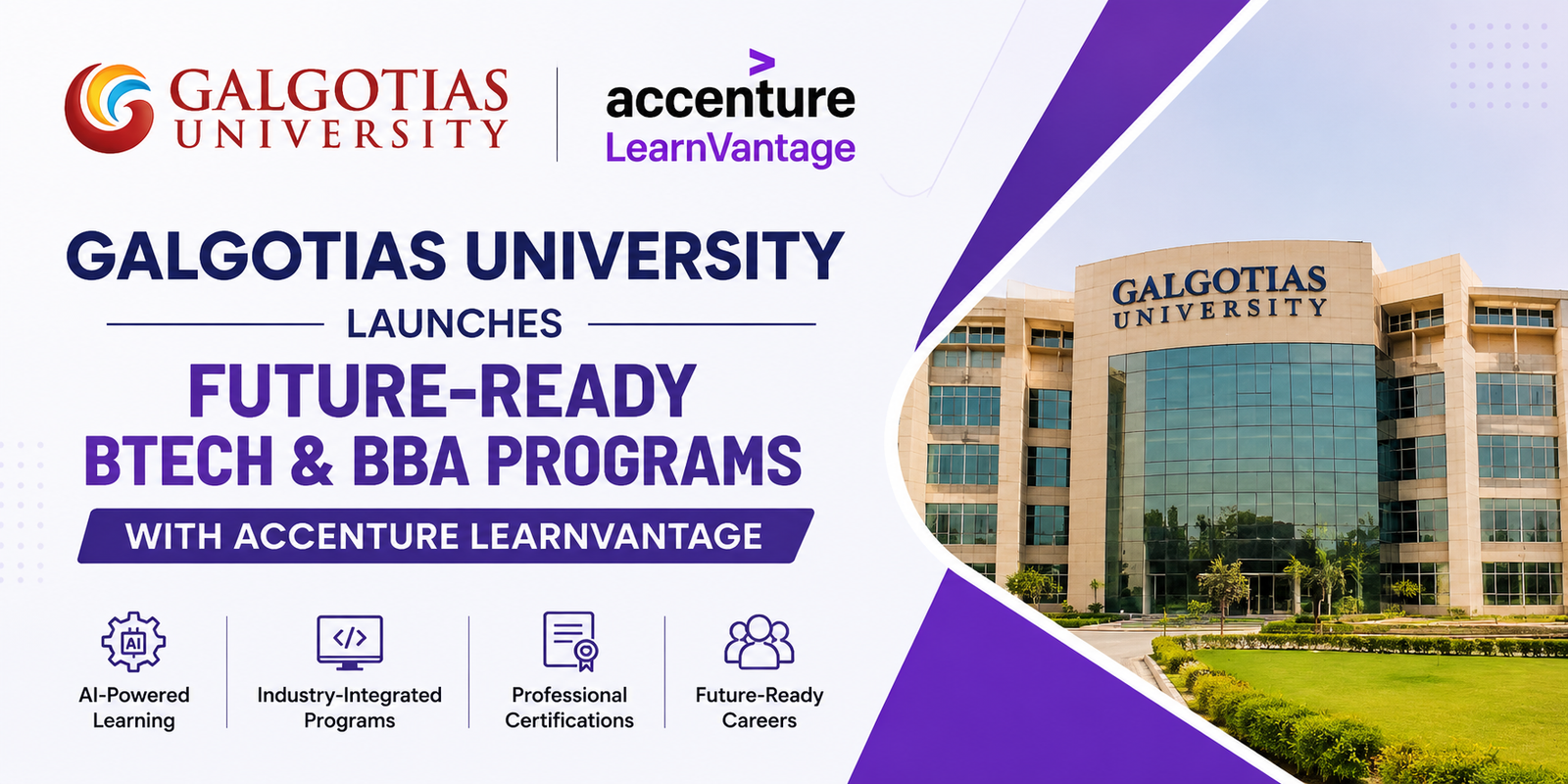
Greater Noida: Galgotias University has announced an industry-academia collaboration with Accenture LearnVantage to introduce a new portfolio of industry-integrated undergraduate programmes focused on technology, business and essential professional skills.
The collaboration aims to prepare students for the rapidly changing job market, particularly in the era of artificial intelligence (AI). The university said the initiative is designed to bridge the gap between classroom learning and workplace expectations by combining academic knowledge with practical technology skills and industry exposure.
Under the new programme portfolio, engineering students will have the opportunity to choose from four specialised BTech disciplines — Cloud and AI, Full Stack Development, Data Science, and Design Engineering. The programmes are designed to incorporate machine learning principles, helping students develop skills relevant to emerging technology-driven careers.
Management students will also have access to two specialised BBA tracks. These include AI-Integrated General Management and AI-Powered Sales and Marketing. The programmes are intended to provide students with an understanding of how artificial intelligence can be applied across business and management functions.
As part of the industry-integrated learning approach, students will get opportunities to work on hands-on projects, virtual labs and professional certifications. The initiative is expected to provide learners with practical exposure alongside their regular academic studies and help them develop skills aligned with evolving industry requirements.
Commenting on the collaboration, Dr. Dhruv Galgotia, CEO, Galgotias University, said that students need to be able to adapt, innovate and apply their knowledge in real-world situations. He described the partnership with Accenture LearnVantage as an important step towards reimagining undergraduate education by combining academic rigour with industry relevance.
According to the university, the future-ready programmes will give students access to contemporary learning experiences, emerging technologies and professional development opportunities. The initiative is aimed at helping students build the technical, business and professional capabilities required for successful careers in a technology-driven economy.
The collaboration is expected to provide students with greater exposure to emerging technologies and industry-oriented learning while helping align undergraduate education with evolving workplace requirements.