IIT Kanpur Inaugurates Wadhwani Innovation Centre for Life Sciences and Medical Technologies
By Administrator | Education | 17-Sep-2026 16:24:20
News Story
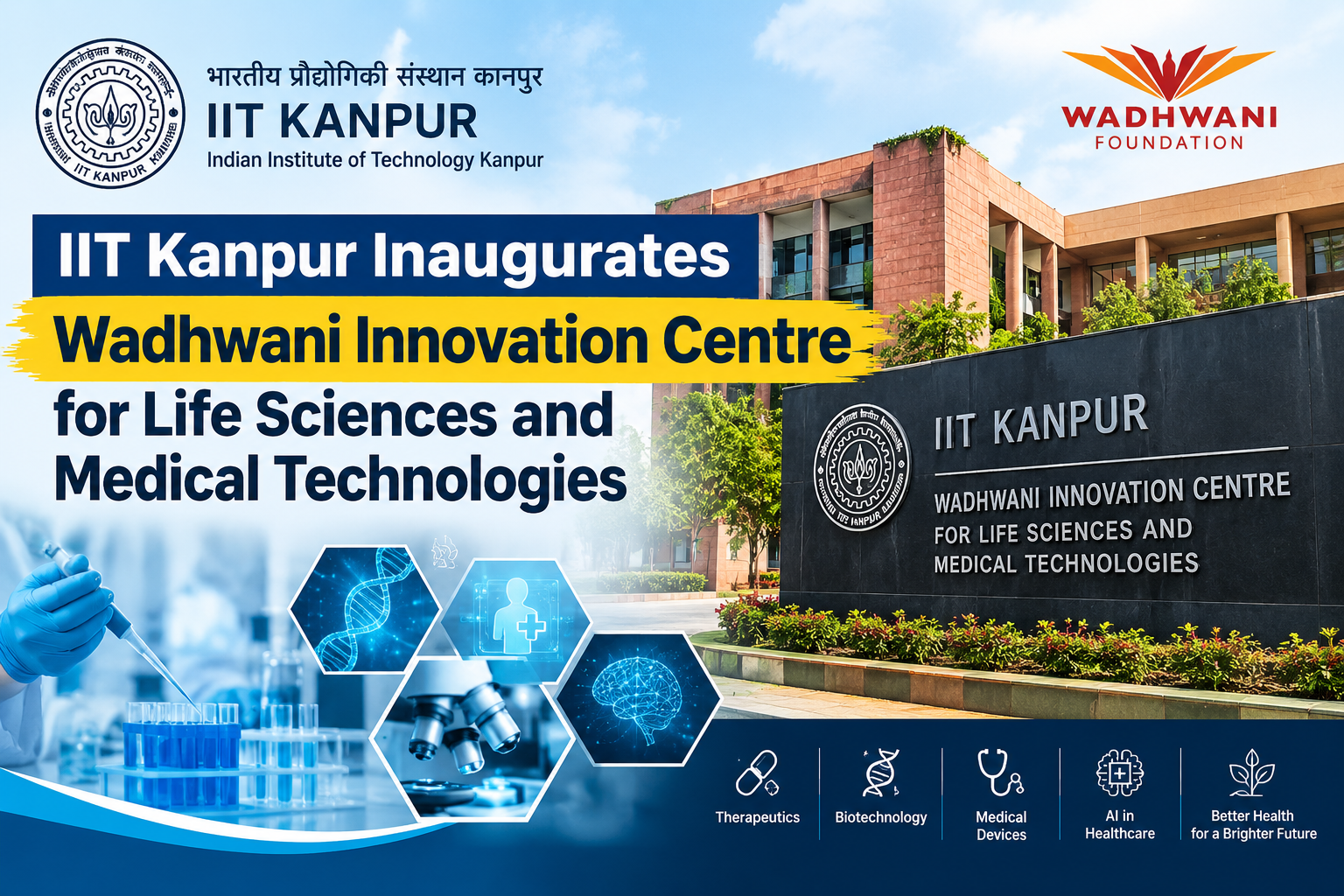
IIT Kanpur Inaugurates Wadhwani Innovation Centre for Life Sciences and Medical Technologies
The Indian Institute of Technology (IIT) Kanpur has taken a significant step toward strengthening healthcare innovation in India with the inauguration of the Wadhwani Innovation Centre for Life Sciences and Medical Technologies. The new Centre of Excellence is designed to help transform promising academic research into practical healthcare products, technologies and solutions.
The centre, established in collaboration with the Wadhwani Innovation Network (WIN), will focus on areas including life sciences, biotechnology, medical technologies, therapeutics, diagnostics and artificial intelligence-enabled healthcare. Its broader objective is to create a stronger pathway between research laboratories and real-world healthcare applications.
The inauguration took place on September 16, 2026, and was attended by Dr. Upendra Kumar Singh, Director General of the Defence Research and Development Organisation (DRDO), New Delhi, along with representatives from IIT Kanpur and the Wadhwani Foundation.
A New Centre for Healthcare and MedTech Innovation
The Wadhwani Innovation Centre for Life Sciences and Medical Technologies, also referred to as the WIN-CoE at IIT Kanpur, aims to strengthen the journey of healthcare innovations from the research stage to validation, technology development and eventual commercialization.
One of the major challenges faced by academic research is the gap between developing an innovative idea in a laboratory and successfully converting that idea into a product or service that can be used in the real world. The new centre is intended to address this gap by providing researchers with support beyond the initial research and proof-of-concept stages.
According to information released around the launch, the centre will support activities such as technology validation, intellectual property processes, regulatory pathways, industry collaboration and commercialization.
This approach can help researchers better understand the requirements involved in taking scientific discoveries toward practical healthcare applications.
$5 Million Funding Commitment Over Five Years
A major component of the initiative is a funding commitment of US$5 million over five years. The funding is intended to support high-potential research and help promising technologies move from laboratory development toward real-world healthcare applications.
Such funding can be particularly important for life sciences and medical technology projects because innovations in these areas often require extensive testing, validation, regulatory processes and industry partnerships before they can reach patients or healthcare providers.
By providing structured support during these stages, the centre aims to create an environment where researchers can focus not only on scientific discovery but also on how their innovations can eventually be translated into useful healthcare solutions.
Key Areas of Research at the Wadhwani Innovation Centre
The new IIT Kanpur centre is expected to work across a broad range of healthcare and life sciences domains.
1. Therapeutics
Therapeutics will be one of the important areas of focus. Research in this field can contribute to the development of new approaches for preventing and treating diseases.
2. Regenerative Medicine
The centre will also support work related to regenerative medicine, an area that explores technologies and biological approaches aimed at repairing or replacing damaged tissues and improving healthcare outcomes.
3. Drug Delivery
Another focus area is drug delivery technology. Innovations in this field can explore improved methods of delivering medicines to specific parts of the body, potentially addressing challenges related to treatment effectiveness and delivery.
4. Vaccines
The centre will support innovation related to vaccines, adding to the broader effort to strengthen India's research and development capabilities in healthcare and biotechnology.
5. Medical Devices and Diagnostics
Medical devices and diagnostic technologies are also included among the centre's focus areas. Innovations in diagnostics can play an important role in identifying diseases and health conditions, while medical devices can support monitoring, treatment and patient care.
6. Artificial Intelligence in Healthcare
The integration of Artificial Intelligence (AI) with healthcare is another important area. AI-enabled technologies are increasingly being explored for applications such as data analysis, diagnostics, healthcare services and decision-support systems.
The centre's focus on AI alongside life sciences and medical technologies reflects the increasingly interdisciplinary nature of modern healthcare research.
Focus on Emerging Healthcare Challenges
Beyond established areas of medical research, the Wadhwani Innovation Centre is also expected to address emerging and critical healthcare challenges.
These include neurodegenerative diseases, mental health, antimicrobial resistance and AI-enabled healthcare services.
Antimicrobial resistance, for example, represents a major research challenge because microorganisms can become resistant to medicines used to treat infections. Similarly, neurodegenerative diseases and mental health require multidisciplinary approaches involving biology, medicine, technology and data science.
By bringing different research capabilities together, the centre could provide a platform for researchers working across multiple disciplines.
Connecting Researchers With Industry
One of the most important aspects of the new centre is its emphasis on industry collaboration.
Scientific research does not automatically become a market-ready product. Researchers often need support in areas such as intellectual property protection, regulatory compliance, product validation, business development and technology transfer.
The Wadhwani Innovation Network describes its broader mission as accelerating translational research and helping move breakthrough research toward products, startups, technologies and scalable solutions. Its network includes innovation centres across leading academic and research institutions.
For IIT Kanpur researchers, this ecosystem can provide additional opportunities to interact with industry partners, entrepreneurs and other innovation stakeholders.
Translational Research: From Lab to Real-World Impact
The concept of translational research is central to the initiative.
In simple terms, translational research focuses on moving scientific discoveries from the laboratory toward practical applications. In healthcare, this could mean transforming an academic research finding into a diagnostic tool, medical device, therapeutic technology or healthcare service.
The centre's launch was followed by a one-day workshop titled “Translational Research and Regulatory Pathways: Bridging Innovation to Healthcare Impact.” The workshop brought together stakeholders from academia, healthcare, industry and regulatory bodies to discuss ways of strengthening the journey from research to healthcare application.
Such discussions are important because healthcare innovation involves multiple stages, from scientific research and validation to regulatory approval, manufacturing, commercialization and eventual adoption.
Strengthening India's Life Sciences Innovation Ecosystem
The establishment of the Wadhwani Innovation Centre at IIT Kanpur comes at a time when India is expanding its focus on research, biotechnology, healthcare technology and deep-tech innovation.
IIT Kanpur already has research and innovation activities spanning multiple technology areas. The institute's research ecosystem includes work across engineering, biological sciences, medical sciences, artificial intelligence and other interdisciplinary domains. IIT Kanpur's official research listings also show positions associated with the Wadhwani Innovation Network Centre of Excellence.
The new centre adds another layer to this ecosystem by focusing specifically on the translation and commercialization of life sciences and medical technology research.
What the New Centre Could Mean for Future Healthcare Innovation
The impact of an initiative like this will ultimately depend on the technologies, startups, research collaborations and healthcare solutions that emerge from it. However, its structure is designed around an important objective: reducing the distance between scientific research and real-world implementation.
For researchers, this can mean greater access to guidance on validation, intellectual property, regulatory processes and industry engagement. For industry, stronger academic-industry connections can create opportunities to identify promising technologies and collaborate on development.
For the broader healthcare ecosystem, successful commercialization of research could contribute to the availability of new medical devices, diagnostics, therapeutics and technology-enabled healthcare solutions.
IIT Kanpur and Wadhwani Foundation's Innovation Partnership
The initiative is part of the wider Wadhwani Innovation Network, which works with academic institutions, industry, governments, philanthropies and other ecosystem partners to accelerate research translation and commercialization.
The network currently identifies IIT Kanpur's focus areas within WIN as synthetic biology and biotechnology, particularly therapeutics, along with artificial intelligence.
The partnership therefore brings together IIT Kanpur's academic and research capabilities with the Wadhwani ecosystem's focus on translational innovation, commercialization and entrepreneurship.
Conclusion
The inauguration of the Wadhwani Innovation Centre for Life Sciences and Medical Technologies at IIT Kanpur marks a new development in India's research and healthcare innovation ecosystem. With a US$5 million funding commitment over five years, the centre will focus on helping promising research move through validation, technology development, regulatory processes and industry collaboration.
Its research priorities span therapeutics, regenerative medicine, drug delivery, vaccines, medical devices, diagnostics, neurodegenerative diseases, mental health, antimicrobial resistance and AI-enabled healthcare.
More importantly, the initiative places emphasis on connecting academic research with practical healthcare needs. As the centre develops its programmes and collaborations, its progress will be measured by how effectively promising scientific ideas can move from laboratories toward validated technologies, startups and solutions capable of addressing real healthcare challenges.