IIT Seats Rise 13.4% Since 2022 to 18,826; Female Supernumerary Seats More Than Double
By Administrator | Education | 24-Oct-2026 12:03:54
News Story
IIT Seats Rise 13.4% Since 2022 to 18,826; Female Supernumerary Seats More Than Double
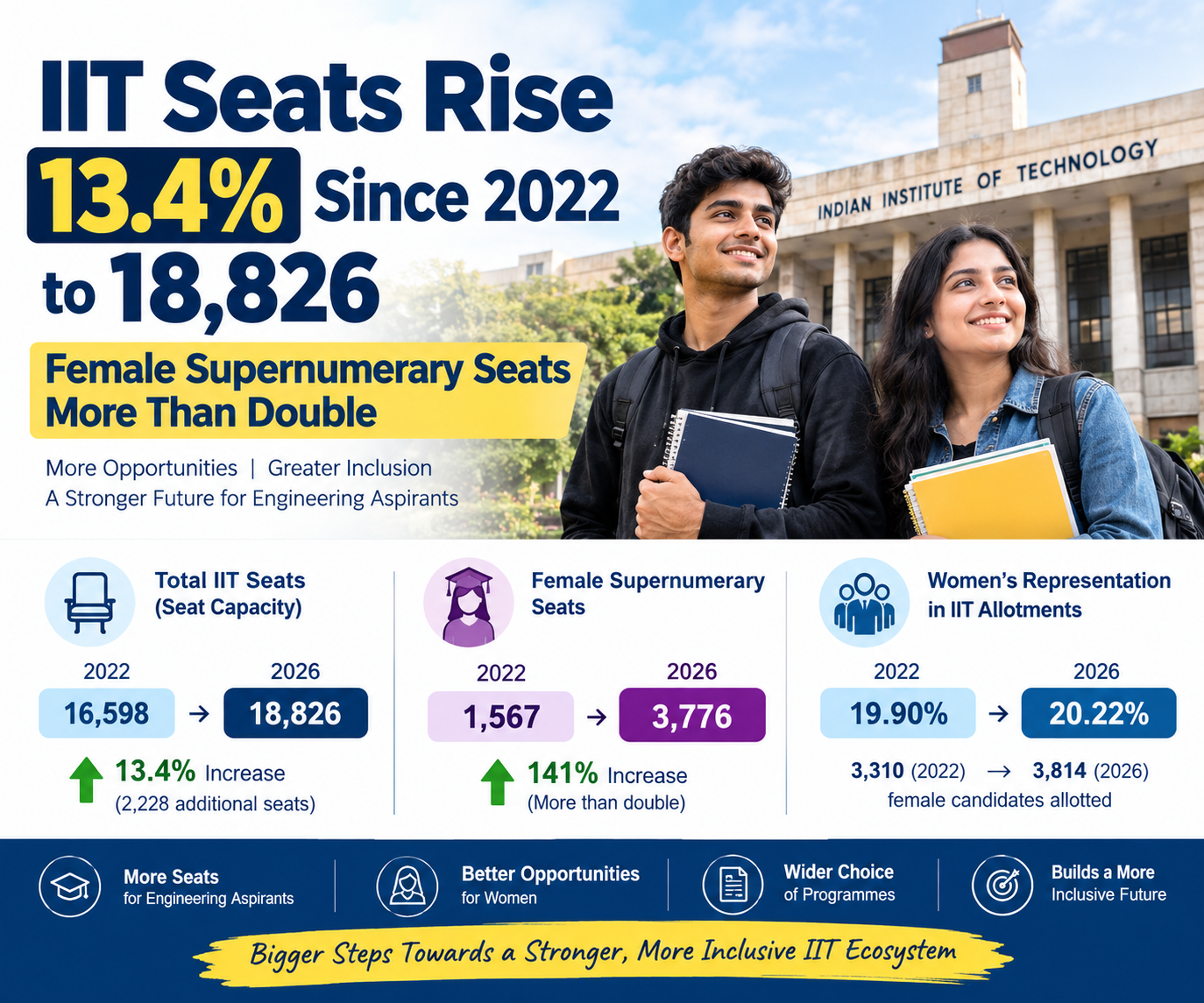
India’s premier engineering institutes have expanded their admission capacity, offering more opportunities to students aspiring to pursue undergraduate engineering programmes. According to the 2026 IIT seat matrix, the total seat capacity across the Indian Institutes of Technology (IITs) has increased by 13.4% since 2022, reaching 18,826 seats. Another significant development is the substantial rise in additional seats created for female candidates, which have more than doubled during the same period. Source: India Today
The increase reflects ongoing efforts to expand access to engineering education and improve women's representation in India's leading technical institutions. For students preparing for the Joint Entrance Examination (JEE), these changes highlight the importance of understanding IIT seat availability, admission procedures and the role of gender-based supernumerary seats.
IIT Seat Capacity Increases by 13.4% Since 2022
The total sanctioned seat capacity across IITs has grown from 16,598 seats in 2022 to 18,826 seats in 2026. This represents an increase of 2,228 seats, or approximately 13.4% over four years.
The expansion provides additional opportunities for candidates competing for admission to undergraduate programmes at IITs. However, securing a seat continues to depend on several factors, including JEE Advanced performance, category-wise eligibility, institute preferences, course availability and the Joint Seat Allocation Authority (JoSAA) counselling process.
The annual increase in seat capacity also reflects changes in the intake of individual institutes and the introduction or expansion of programmes. Students should therefore review the latest official seat matrix before making decisions about their preferred engineering colleges and branches.
IIT Seat Capacity: 2022 vs 2026
The following figures illustrate the growth in overall IIT seat capacity:
2022: 16,598 seats
2026: 18,826 seats
Additional seats: 2,228
Overall growth: 13.4%
These figures refer to seat capacity, which is different from the final number of seats allotted during counselling. In 2026, the final counselling allotment reached 18,861 seats, including certain supernumerary allotments beyond the stated capacity.
Female Supernumerary Seats More Than Double
One of the most notable developments in IIT admissions is the increase in female-only supernumerary seats. These additional seats are designed to improve women's participation in undergraduate engineering programmes without reducing the regular seat pool available to other eligible candidates.
According to the JEE Advanced admission data, female supernumerary seats increased from 1,567 in 2022 to 3,776 in 2026. This represents a rise of approximately 141%, meaning the number of such seats has more than doubled.
The expansion is part of a broader effort introduced in 2018 to address the historically low representation of women in IITs. The policy aimed to increase female enrolment and move towards a target of approximately 20% representation in undergraduate programmes.
The increase in female-only seats provides more admission opportunities for eligible women candidates. Nevertheless, admission is not automatic, and applicants must still satisfy the applicable examination, eligibility and counselling requirements.
What Are Female Supernumerary Seats in IITs?
Supernumerary seats are additional seats created over and above the regular intake. In the context of IIT admissions, female-only supernumerary seats were introduced to improve gender representation in engineering education.
These seats differ from ordinary seats in the counselling process because they are intended specifically for eligible female candidates under the applicable admission rules.
The objective is to encourage greater participation by women in technical education while maintaining the regular seat pool. The initiative is particularly relevant because engineering has historically experienced gender imbalances in several specialised fields.
However, students should not confuse female supernumerary seats with a guaranteed admission opportunity. Candidates must qualify through the prescribed admission route and meet the relevant conditions for their chosen programme and institute.
IIT Admissions 2026: Women's Representation Reaches Around 20%
The increase in additional seats has contributed to higher numbers of female candidates securing admission to IITs. However, the proportion of women among all allotted seats has remained close to one-fifth in recent years.
According to the 2026 admission figures, 3,814 female candidates received IIT seat allotments out of 18,861 total allotments. Women therefore accounted for approximately 20.22% of the total.
For comparison, 3,310 female candidates received allotments in 2022, when women represented approximately 19.90% of the total allotments.
These figures indicate that the number of women entering IITs has increased, although their overall share has changed only modestly. The additional seats have helped expand opportunities, but further progress in gender representation also depends on participation in entrance examinations, access to preparation resources and students' choices of engineering programmes.
How Does the Increase in IIT Seats Benefit Engineering Aspirants?
The rise in IIT seat capacity is an important development for students preparing for competitive engineering entrance examinations. Although the increase does not remove the intense competition for admission, it expands the overall number of available places.
Here are some potential benefits of the expansion:
1. More Available Seats
An increase of 2,228 seats compared with 2022 expands the number of places available across the IIT system. This provides additional opportunities for candidates who qualify for admission.
2. Greater Opportunities for Female Candidates
The growth in female supernumerary seats creates additional opportunities for eligible women pursuing engineering degrees. It also supports efforts to improve gender diversity in technical institutions.
3. Wider Programme Choices
Changes in institute capacity and programme intake may affect the options available to students across different engineering branches. Applicants should check the official seat matrix to identify courses and institutes that match their interests and admission prospects.
4. Importance of Counselling Strategy
JoSAA counselling plays an important role in allocating seats based on candidates' ranks, category, preferences and applicable rules. Students should carefully arrange their institute and course preferences rather than relying solely on the overall increase in seats.
JEE Advanced and JoSAA Counselling: What Students Should Know
Admission to undergraduate programmes at IITs generally requires candidates to qualify through JEE Advanced and participate in the applicable seat-allocation process. JEE Main is an important first step because candidates must meet the eligibility requirements to appear for JEE Advanced.
After the entrance examination, eligible candidates participate in the counselling process conducted through JoSAA. Seat allocation depends on factors such as the candidate's rank, category, programme preferences, seat availability and the applicable admission rules.
The increase in IIT seats does not mean that every candidate will have a higher chance of securing a preferred branch. Highly sought-after programmes and institutes may continue to attract substantial competition.
Students should consult official JEE Advanced and JoSAA announcements for the latest eligibility requirements, counselling schedules, seat matrices and allotment results.
Official reference: https://jeeadv.ac.in/
Will IIT Seats Continue to Increase in the Future?
The rise in IIT capacity between 2022 and 2026 demonstrates an expansion in available undergraduate engineering seats. However, future changes will depend on official decisions regarding institute intake, new programmes, infrastructure and admission policies.
Students should avoid assuming that the same growth rate will continue in subsequent admission cycles. The official seat matrix for each year remains the most reliable reference for determining the number of available seats.
Similarly, the future direction of female supernumerary seats will depend on applicable policy decisions and admission data. Continued efforts to improve women's participation may involve both additional seats and broader initiatives supporting access to engineering education.
Conclusion
The increase in IIT seat capacity to 18,826 in 2026 represents 13.4% growth since 2022, adding 2,228 seats across India's premier engineering institutes. At the same time, female-only supernumerary seats have risen from 1,567 to 3,776, an increase of approximately 141%.
These developments mark an important expansion in opportunities for engineering aspirants, particularly women seeking admission to IITs. However, the number of available seats is only one part of the admission process. Examination performance, eligibility, course preferences and counselling decisions remain crucial for securing admission.
Students planning to pursue engineering should stay informed about the latest JEE Advanced notifications, IIT seat matrices and JoSAA counselling updates to make well-informed admission decisions.
Frequently Asked Questions (FAQs)
1. How many seats are available in IITs in 2026?
The total IIT seat capacity for 2026 is 18,826 seats, according to the reported seat matrix.
2. By what percentage have IIT seats increased since 2022?
IIT seat capacity has increased by approximately 13.4%, rising from 16,598 seats in 2022 to 18,826 in 2026.
3. How many female supernumerary seats are available in 2026?
The 2026 seat matrix includes 3,776 female-only supernumerary seats.
4. What is the purpose of female supernumerary seats in IITs?
These additional seats aim to improve women's representation in undergraduate engineering programmes without reducing the regular seat pool.
5. Is JEE Advanced required for IIT admission?
Admission to IIT undergraduate programmes generally requires qualifying through JEE Advanced and participating in the prescribed counselling process, subject to the applicable eligibility rules.
6. Does an increase in IIT seats guarantee admission?
No. Admission depends on examination performance, eligibility, category, programme preferences, seat availability and the applicable counselling rules.