Indian Medical Students Face Degree Uncertainty as Kyrgyzstan Blacklists 13 Universities
By Administrator | Education | 24-Sep-2026 13:12:52
News Story
Indian Medical Students Face Degree Uncertainty as Kyrgyzstan Blacklists 13 Universities
New Delhi: Indian medical students pursuing MBBS and other medical programs in Kyrgyzstan are facing uncertainty over their education and future registration in India after 13 medical universities failed Kyrgyzstan’s mandatory state accreditation process. The development has raised concerns among Indian students and their families, particularly over university transfers, recognition of completed coursework, and eligibility for medical registration in India.
The issue emerged after Kyrgyzstan introduced a state accreditation process for medical universities and colleges. According to an advisory issued by the Embassy of India in Bishkek, medical institutions were required to undergo the accreditation process, with the process linked to their authority to admit students and issue state-standard educational documents.
Reports published in September 2026 said that licenses of medical universities that failed the accreditation process were suspended. Kyrgyz authorities have also initiated the redistribution of affected students to accredited institutions.
What Happened to 13 Medical Universities in Kyrgyzstan?
The latest development is linked to Kyrgyzstan's state accreditation exercise for medical education institutions.
According to reports, 24 educational organizations applied for state accreditation, while 13 medical universities did not successfully pass the process. As a result, these institutions were not permitted to continue educating students under the applicable regulatory framework.
The Embassy of India has previously advised Indian students to carefully check the accreditation status of medical universities before taking admission in Kyrgyzstan.
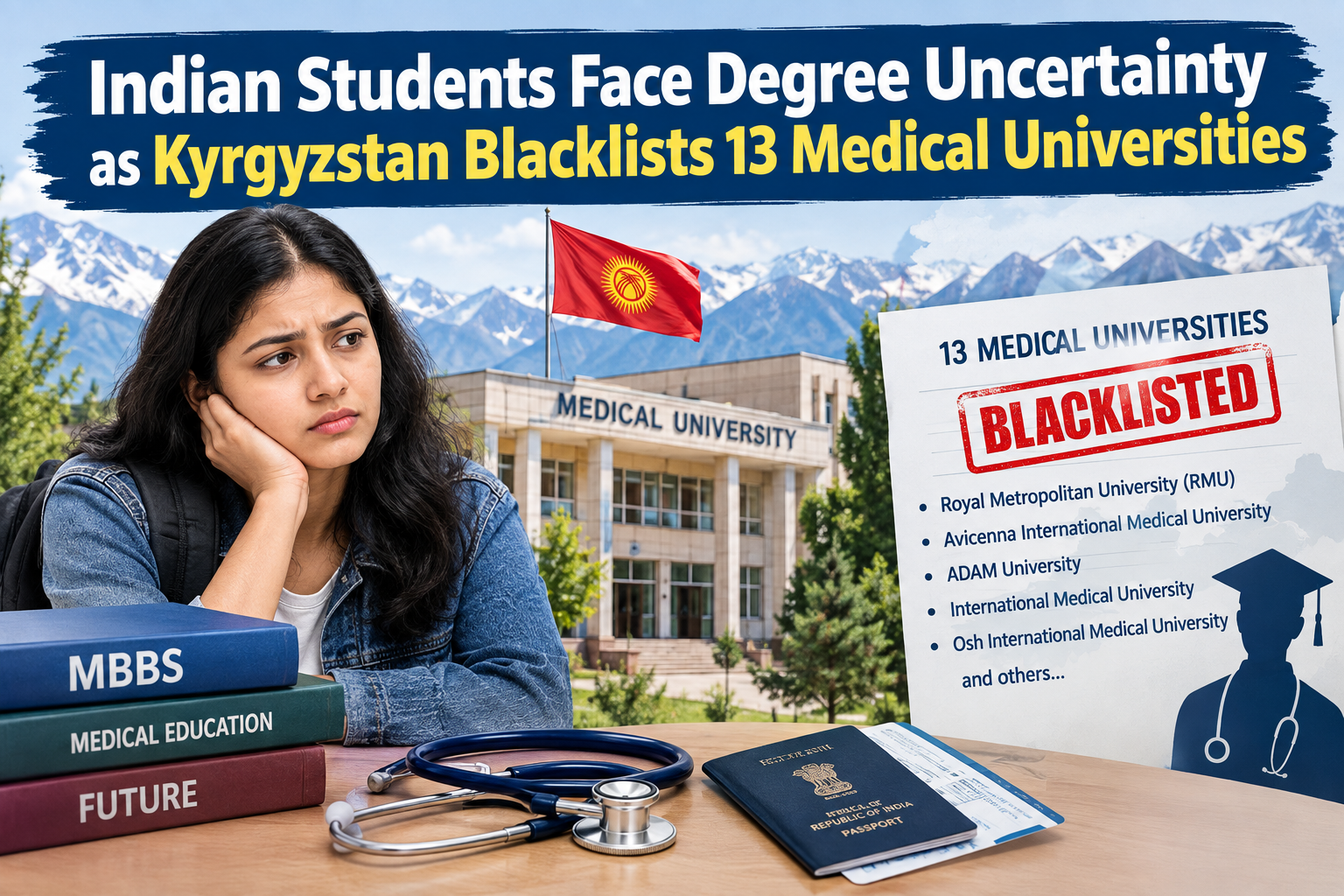
The institutions identified in reports include Royal Metropolitan University (RMU), Avicenna International Medical University, ADAM University, International Medical University, and Osh International Medical University, among others.
The term “blacklisted” is being widely used in reports and online discussions, but the underlying issue is the failure to obtain the required Kyrgyz state accreditation and the resulting regulatory action.
Why Are Indian Students Worried About Their Degrees?
The biggest concern for Indian students is not simply whether they can continue studying, but whether their academic records, clinical training, and eventual medical qualification will satisfy the requirements applicable when they return to India.
Kyrgyz authorities have reportedly created a mechanism to transfer students from institutions that failed accreditation to universities that have successfully obtained accreditation. The Kyrgyz Ministry of Health issued a procedure for transferring affected students and identified institutions that could receive them.
However, Indian students have raised questions about how the transfer will affect their academic progression.
Students may need clarity on issues such as:
Whether previously completed coursework will be fully recognized.
How academic credits will be transferred.
Whether clinical training is already completed will be counted.
Whether students will have to repeat part of their course.
Whether the final qualification will meet Indian regulatory requirements.
How the transfer will affect the duration of their medical education.
Whether the receiving university satisfies all applicable requirements.
These questions are particularly important because foreign medical graduates must meet the requirements applicable in India before obtaining medical registration.
What Does the Indian Embassy Say?
The Embassy of India in Bishkek has repeatedly advised Indian students to exercise due diligence before choosing a medical university in Kyrgyzstan.
Its advisory states that students should verify the university, course details, fee structure, and other relevant information directly before taking admission. The Embassy has also cautioned students about misleading information provided by educational consultants and contractors.
The Embassy's guidance also highlights an important requirement concerning foreign medical education. According to the advisory, the entire course, training and internship or clerkship should be completed outside India in the same foreign medical institution throughout the course, subject to the applicable regulatory framework.
This requirement is one reason the current transfer issue has attracted particular attention from Indian medical students.
What Happens to Students from Non-Accredited Universities?
Kyrgyz authorities have established a transfer process for students enrolled at institutions that did not pass the state accreditation process.
According to reports, affected students are being redistributed to accredited universities. Kyrgyzstan's Ministry of Health has also stated that the licenses of institutions that failed accreditation were suspended from September 7, 2026.
The authorities have indicated that students are being transferred as part of the previously established procedure.
However, the transfer does not automatically resolve all concerns for Indian students. The students still need clarity about whether their complete academic history will be accepted by the receiving institution and whether their eventual qualification will satisfy Indian requirements.
This distinction is important because transferability under Kyrgyzstan's system and eligibility for medical registration in India are separate issues.
What Does NMC Say About Foreign Medical Universities?
Indian students planning to study medicine abroad should also understand that the National Medical Commission (NMC) does not simply endorse a general list of foreign universities for MBBS.
The Embassy of India in Bishkek has specifically clarified that the NMC does not endorse a list of foreign medical institutions or universities for MBBS or equivalent courses. Students are advised to independently verify the course structure, duration, internship requirements, and other applicable conditions before admission.
For foreign medical graduates, meeting the applicable Indian regulatory requirements is essential for pursuing medical registration in India.
Therefore, students should not assume that a university's presence on a website, an international accreditation claim, or marketing material automatically means that its degree will be sufficient for practicing medicine in India.
Why Is Accreditation Important for Medical Students?
Accreditation is particularly important in medical education because universities need regulatory approval to conduct recognized programs and issue relevant educational documents.
In the current Kyrgyzstan situation, institutions that failed the state accreditation process faced restrictions on their ability to continue educating students. Reports indicate that licenses of the affected medical universities were subsequently suspended.
The development has therefore created an additional layer of verification for students considering MBBS in Kyrgyzstan.
Before paying admission fees, students should check the university's current state accreditation status, license status, and program details instead of relying solely on older certificates or claims made by private admission agencies.
International Accreditation Is Not the Same as State Accreditation
One important point in the Kyrgyzstan controversy is the distinction between international accreditation and state accreditation.
A university may have an international accreditation or institutional recognition claim, but that does not necessarily replace the mandatory state accreditation required under Kyrgyzstan's current regulatory framework.
The Indian Express reported the example of Royal Metropolitan University, whose website states that it holds international institutional accreditation. However, the Embassy's advisory concerning the 2026 Kyrgyz state accreditation process listed the institution among those that had not passed that process.
Therefore, students should check the specific accreditation required by the country's medical education regulator rather than treating different types of accreditation as interchangeable.
More Than 2,000 Indian Students Could Be Affected
The current situation has also prompted representations from student groups seeking clarity from Indian authorities.
The All India Medical Students' Association – Foreign Medical Students' Wing (AIMSA-FMSW) has sought intervention from the Ministry of External Affairs and other authorities over the issue. The organization has estimated that the development could affect more than 2,000 Indian students and their families. This figure is an estimate attributed to the association and has not been independently verified.
The association has sought a clear mechanism for transferring affected Indian students and written clarification regarding the recognition of degrees earned after such transfers.
It has also sought clarity about the accreditation status of receiving institutions and whether education completed after transfer would satisfy the requirements applicable for medical registration in India.
What Should Indian Students Do Now?
Students currently enrolled in a Kyrgyz medical university should avoid relying on social media posts or informal messages regarding the status of their university.
Instead, students and parents should verify information through official channels.
1. Check the University's Current Accreditation Status
Students should confirm whether their institution has passed the latest Kyrgyz state accreditation process.
2. Verify the Licence Status
If a university's licence has been suspended, students should obtain official information about the implications and transfer process.
3. Ask for Written Transfer Details
Students being transferred should obtain written information about the receiving university, course structure, credits, academic year and clinical training.
4. Check NMC Requirements
Students should independently verify the current requirements applicable to foreign medical graduates before assuming that a transfer will automatically preserve their eligibility for registration in India.
5. Keep Academic Records
Students should retain copies of admission documents, fee receipts, transcripts, attendance records, clinical training records and other academic documents.
6. Verify Information Before New Admission
Students planning to join a medical university in Kyrgyzstan should verify the institution's current regulatory status before making any payment.
The Indian Embassy has specifically advised students to exercise due diligence while taking admission, particularly in private universities.
Kyrgyzstan MBBS Accreditation Issue: Key Facts
| Particular | Details |
|---|---|
| Country | Kyrgyz Republic |
| Issue | State accreditation of medical institutions |
| Universities affected | 13 institutions reportedly failed accreditation |
| Applications for accreditation | 24 educational organisations |
| Action | Licences of failed institutions suspended |
| Student support | Transfer mechanism established |
| Concern for Indian students | Academic transfer and future Indian registration |
| Indian authority involved | Embassy of India in Bishkek / NMC framework |
| Current advice | Verify accreditation, licence and course requirements |
What Does This Mean for Future MBBS Admissions in Kyrgyzstan?
The development is likely to make regulatory verification an even more important part of the MBBS abroad admission process.
Students considering Kyrgyzstan should not select a university only because of its tuition fees, location, hostel facilities or claims made by an education consultant.
The university's current legal and accreditation status, medical programme structure, clinical training arrangements and compatibility with Indian regulatory requirements should all be checked before admission.
The Embassy of India has also warned students about misleading information from educational consultants and contractors. It advises students to verify the credentials of consultants and the information supplied to them before signing contracts or making payments.
Conclusion
The accreditation crisis involving 13 medical universities in Kyrgyzstan has created uncertainty for Indian students studying medicine in the country. While Kyrgyz authorities have established a mechanism to transfer students from non-accredited institutions to accredited universities, questions remain regarding academic credits, clinical training, course continuity and eventual eligibility for medical registration in India.
The situation also highlights the importance of checking current state accreditation and licensing status before choosing a foreign medical university.
For existing students, official information from Kyrgyz authorities, the Embassy of India and relevant Indian medical regulators will be important as the transfer process progresses. For prospective students, verifying the university's latest regulatory status and understanding the applicable foreign medical graduate requirements should be treated as an essential step before admission.
Source References
Embassy of India, Bishkek – Advisory for Indian students studying medicine in Kyrgyz Republic.
Indian Express – Report on 13 non-accredited medical universities and concerns of Indian students.
Kyrgyzstan Ministry of Health-related report on suspension of licences and student redistribution.
Kyrgyzstan state accreditation reporting.