Tell Modi to Sack Gyanesh Kumar, Protests Will Stop in 30 Seconds: Rahul Gandhi to Traders
By Administrator | National | 26-Oct-2026 15:55:41
News Story
Tell Modi to Sack Gyanesh Kumar, Protests Will Stop in 30 Seconds: Rahul Gandhi to Traders
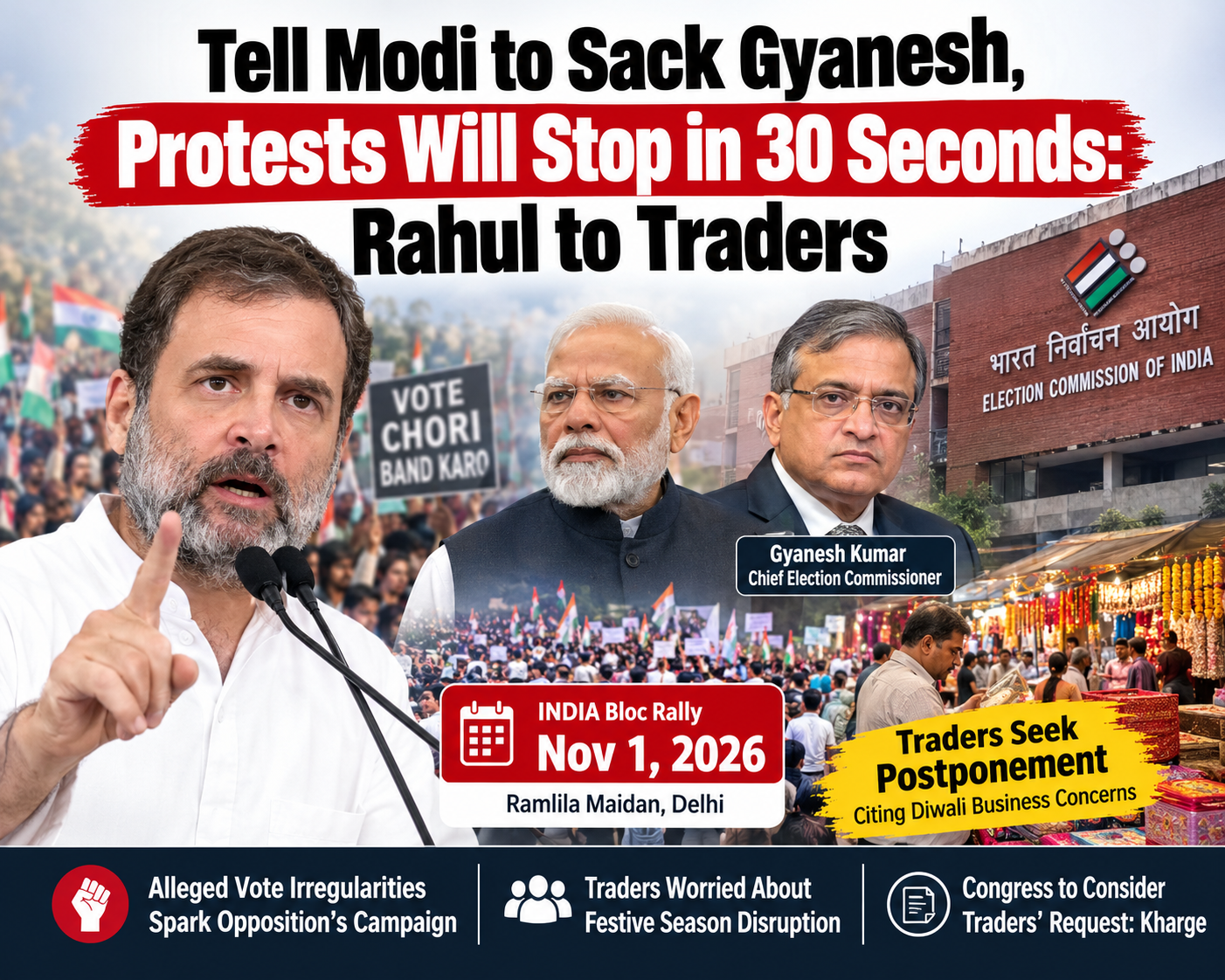
Congress leader Rahul Gandhi has urged Delhi traders to ask Prime Minister Narendra Modi to remove Chief Election Commissioner Gyanesh Kumar, saying the ongoing protests could end within 30 seconds if his demand is met. His statement comes amid concerns raised by the business community over the INDIA bloc's proposed November 1 rally at Ramlila Maidan in New Delhi. Traders have requested that the rally be postponed until after the festive season, citing potential disruptions to retail and wholesale business.
The controversy has brought three major issues into focus: the Opposition's allegations of vote irregularities, the role of the Election Commission of India, and the economic concerns of traders during the busy Diwali shopping season.
Rahul Gandhi's Statement to Delhi Traders
On October 26, 2026, Rahul Gandhi addressed Delhi's business community through a post on social media platform X. He expressed solidarity with traders and argued that restrictions on public transport and roads during protests had affected normal movement across the national capital.
Gandhi said that the government should remove Chief Election Commissioner Gyanesh Kumar if it wanted the protests to stop. He also linked the Opposition's campaign against alleged vote theft to the security of businesses, personal savings and the future of families.
His statement, asking traders to tell the Prime Minister to sack Gyanesh Kumar, has become the central point of the latest political debate.
The Congress leader's remarks reflect the Opposition's position that concerns surrounding electoral processes must be addressed before the political confrontation can be resolved.
However, the allegations of electoral irregularities remain contested political claims and should not be treated as established findings without supporting evidence or official conclusions.
Why Is Rahul Gandhi Demanding Gyanesh Kumar's Removal?
Chief Election Commissioner Gyanesh Kumar has faced criticism from Opposition parties over the functioning of the Election Commission and the Special Intensive Revision (SIR) of electoral rolls.
The Congress and other Opposition leaders have raised concerns about voter-list revisions, alleged irregularities and the transparency of the electoral process. They have demanded accountability and changes to the way these issues are handled.
The Special Intensive Revision is an exercise aimed at reviewing and updating electoral rolls. Such revisions can involve checking voter details, identifying eligible voters and addressing inaccuracies in electoral records.
The Opposition has questioned aspects of the process and alleged that it could affect eligible voters. It has called for greater transparency and corrective action where irregularities are established.
Rahul Gandhi's demand for Gyanesh Kumar's removal is part of this broader political campaign. The Congress has argued that public confidence in elections depends on the transparency, impartiality and accountability of electoral institutions.
The Election Commission's role is especially important because it oversees elections and manages electoral processes under the constitutional and legal framework governing elections in India.
The controversy highlights the continuing disagreement between the Opposition and the government over electoral administration and institutional accountability.
INDIA Bloc Plans November 1 Rally at Ramlila Maidan
The INDIA bloc has planned a rally at Delhi's Ramlila Maidan on November 1, 2026, as part of its campaign against alleged vote theft and concerns about electoral-roll revisions.
The proposed demonstration is intended to bring attention to the Opposition's demands and increase pressure on the government and the Election Commission.
The rally is expected to draw political workers, supporters and other participants. However, large public gatherings in central Delhi can require traffic diversions, security arrangements and restrictions around important roads or public transport facilities.
These arrangements have become a concern for traders who depend on regular customer movement, particularly during the festive shopping season.
The proposed rally has therefore created a debate about how political demonstrations can proceed while limiting disruption to businesses and the general public.
For the INDIA bloc, the rally is part of a wider political campaign. For traders, the immediate concern is protecting commercial activity during one of the busiest periods of the year.
Delhi Traders Request Postponement of the Rally
The Chamber of Trade and Industry (CTI) has requested that Rahul Gandhi and the Opposition leadership postpone the November 1 rally until after November 10.
CTI chairman Brijesh Goyal highlighted the potential impact of the demonstration on Delhi's retail and wholesale markets. According to the traders' body, the rally's timing could create difficulties for businesses preparing for Dhanteras, Diwali and Bhai Dooj.
These festivals traditionally bring increased demand for clothing, jewellery, electronics, household goods, sweets, gifts and other products.
Traders often depend on the weeks leading up to these occasions to generate a substantial portion of their seasonal revenue. Any significant disruption to customer movement can therefore create concerns for shopkeepers, wholesalers, distributors and other businesses.
The CTI has argued that road closures, traffic diversions and restrictions on access to commercial areas could discourage customers from visiting markets.
The organisation has requested a later date for the rally so that businesses can complete their important festive-season trading activities.
The request places the Opposition leadership in a difficult position: it must consider the business community's concerns while deciding how to continue its political campaign.
Why the Festive Season Matters for Delhi's Economy
Delhi is one of India's major commercial centres, with extensive wholesale and retail markets serving customers from the capital and neighbouring states.
Markets dealing in jewellery, garments, electronics, dry fruits, utensils, sweets, automobiles and gifts generally experience increased activity during the festive season.
Dhanteras, Diwali and Bhai Dooj are particularly important for businesses because consumers often make purchases for personal use, family celebrations and gifting.
The CTI has highlighted the scale of festive trade in Delhi and warned that disruptions could affect business worth thousands of crores of rupees.
For small retailers, even a temporary decline in customer footfall can affect daily sales and cash flow. Wholesalers may also face delivery delays if vehicles cannot access markets easily.
Transport restrictions can create additional challenges for customers travelling from residential areas to shopping districts. Businesses operating in crowded commercial areas may be especially concerned about parking, road access and the movement of goods.
Nevertheless, the actual financial impact of a particular rally would depend on factors such as its size, location, duration and the traffic arrangements implemented by authorities.
The traders' request reflects a practical concern: public demonstrations and commercial activity must be managed in a way that minimises avoidable disruption.
Mallikarjun Kharge Says Congress Will Consider Traders' Concerns
Congress president Mallikarjun Kharge has also responded to the concerns raised by Delhi's business community.
Kharge indicated that the party leadership would consider the traders' request and look for a possible solution. At the same time, he maintained that the Opposition's campaign against alleged electoral irregularities remained important.
This response suggests that the Congress leadership is weighing the concerns of traders against its decision to continue the political movement.
Postponing a rally, changing its arrangements or maintaining the original schedule would each have different implications for political mobilisation and local businesses.
The final decision would need to account for the practical arrangements required for a large public gathering, as well as the concerns of traders and residents.
The discussion also demonstrates how political events can affect groups beyond the immediate participants, including commuters, local shopkeepers, transport operators and customers.
What Is the Connection Between Vote Chori Allegations and the Protests?
The phrase "vote chori" has become a prominent part of the Congress campaign against alleged irregularities in electoral processes.
The Opposition argues that electoral rolls must be accurate, voter information must be handled transparently, and eligible citizens must be able to exercise their voting rights without unnecessary obstacles.
The SIR exercise has become a particular focus of these concerns. Opposition leaders have called for greater clarity regarding the revision process and action against any proven irregularities.
The government and election authorities have a responsibility to administer elections within the applicable legal framework. Questions about electoral rolls can be addressed through official records, established procedures and appropriate legal mechanisms.
The political disagreement centres on whether the existing processes provide sufficient transparency and safeguards.
Rahul Gandhi's latest statement connects this broader democratic debate with the immediate concerns of Delhi's traders. His argument is that the dispute over electoral integrity should be resolved rather than allowing protests and restrictions to continue.
The claim that removing the Chief Election Commissioner would end the protests within 30 seconds is a political statement, not a confirmed prediction of how events would unfold.
What Happens Next?
The next important development is likely to be the Opposition leadership's response to the traders' request regarding the November 1 rally.
If the event proceeds as planned, authorities may need to coordinate security, traffic management and public transport arrangements to reduce disruption around Ramlila Maidan and nearby commercial areas.
If the rally is postponed or its arrangements are changed, the decision could help address some of the concerns raised by the business community. However, that would not necessarily resolve the larger disagreement over electoral reforms and the Election Commission.
The Opposition is expected to continue raising questions about voter-list revisions and alleged electoral irregularities, while traders are seeking measures that protect their businesses during the festive period.
For the public, the key issues are transparency, accountability, access to markets and the smooth functioning of democratic institutions.
Any claims of electoral wrongdoing must be assessed on the basis of verifiable evidence, while the financial consequences of public demonstrations should be evaluated using reliable business and economic data.
Conclusion
Rahul Gandhi's statement that protests would stop within 30 seconds if Prime Minister Narendra Modi removed Chief Election Commissioner Gyanesh Kumar has intensified the debate surrounding the INDIA bloc's planned November 1 rally in Delhi.
The remarks came after the Chamber of Trade and Industry requested a postponement, citing concerns about potential disruption to business during the festive shopping season.
At the centre of the controversy are the Opposition's allegations of electoral irregularities, its demand for accountability from the Election Commission, and the business community's concern about protecting festive-season sales.
As the debate continues, the response of the Congress leadership and the arrangements made for the proposed rally will be important developments to watch.
The broader challenge is to address concerns about electoral transparency while ensuring that public demonstrations, transport services and commercial activities can function with minimal avoidable disruption.