NASA locks in key milestone as Artemis II rocket gets Orion stage adapter
By | Science | 05-Oct-2025 17:01:51
News Story
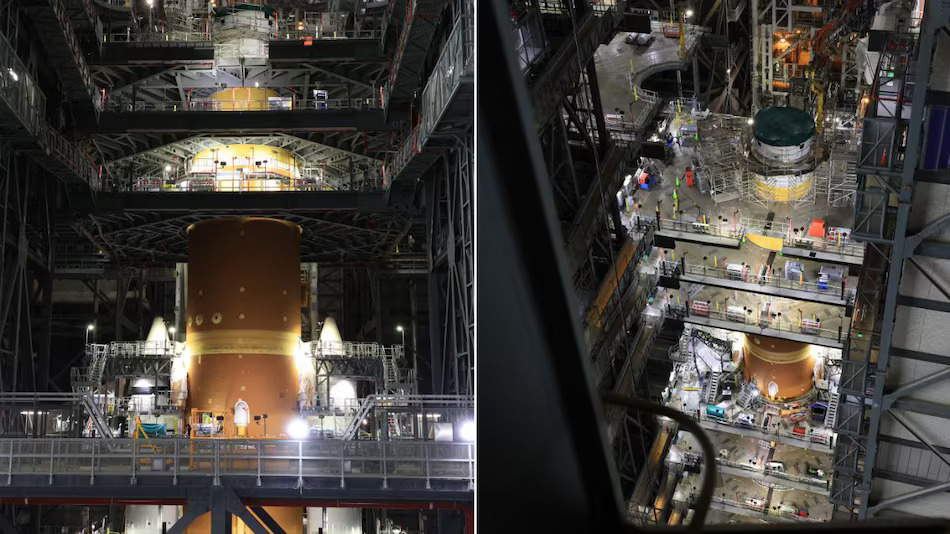
NASA has inched closer to its first crewed lunar flight in more than half a century, completing the integration of the Orion stage adapter with the powerful Space Launch System (SLS) rocket for the Artemis II mission.
The milestone, achieved at the Kennedy Space Center in Florida, advances
preparations for the launch scheduled for April 2026.
The Orion stage adapter, built by engineers in
Alabama, is a critical component that links the rocket’s interim cryogenic
propulsion stage to the Orion spacecraft. Fitted with a protective diaphragm,
it shields the crew capsule from hazardous gases during launch. Later in the
mission, it will deploy four CubeSats — compact satellites from South Korea,
Germany, Argentina, and Saudi Arabia — carrying scientific experiments into
high Earth orbit once Orion is safely on its way.
Over the coming weeks, engineers at Kennedy
will attach the Orion spacecraft to the rocket and conduct rigorous system
tests to validate mission readiness. Parallel work on Artemis III hardware is
also underway to ensure NASA’s long-term lunar timeline remains on track.
Artemis II will mark the first crewed voyage of the program, sending astronauts on a lunar flyby to test spacecraft systems before a Moon landing on Artemis III. Beyond its technical significance, the successful integration underscores both NASA’s push for sustainable lunar exploration and the growing international role in deep-space science.