Parliament set for historic shake-up of higher education; government to replace UGC, AICTE with single mega-regulator
By | Education | 23-Nov-2025 14:16:54
News Story
In what could become the most significant education reform in decades, Parliament is poised to debate a bill that will dismantle India’s long-standing higher education regulatory architecture and replace it with a single overarching authority.
When the Winter Session begins on December 1, the government plans to table
the Higher Education Commission of India
(HECI) Bill, officially marking the push to phase out bodies such as
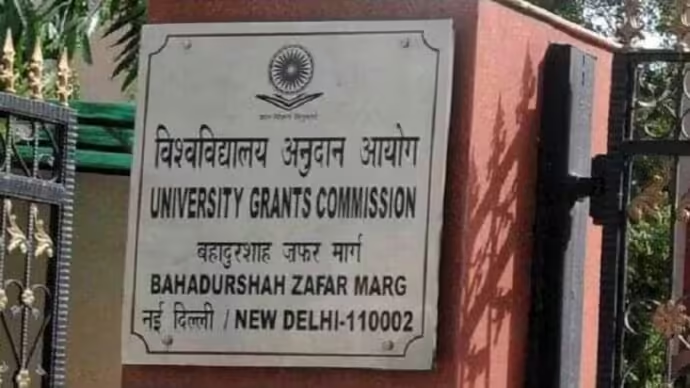
the University Grants Commission (UGC), All India Council for Technical
Education (AICTE) and National Council for Teacher Education (NCTE).
The reform — rooted in the National Education Policy (NEP) 2020 — seeks to end the fragmented regulatory structure that has governed universities and professional institutions for decades.
Currently, the UGC oversees non-technical education, the AICTE supervises
technical degrees, and the NCTE regulates teacher-training programmes. Under
the proposed system, all three domains will fall under a single regulator.
However, the Bill will not extend to medical or legal education, which will
remain under their existing regulatory bodies — a key carve-out designed to
maintain sector-specific oversight.
The new commission is expected to operate on
three core functions: regulation, accreditation and the setting of academic and
professional standards. Funding powers,
notably, will not shift to HECI and will continue to be managed by the
administrative ministry — a deliberate separation meant to ensure clear
boundaries between regulation and financial governance.
The idea of a unified regulator has been in
circulation for years. A draft HECI Bill released in 2018 — then framed around
repealing the UGC Act — invited extensive public feedback but never moved
forward. The effort gained renewed traction in 2021 after Dharmendra Pradhan
took charge as Union Education Minister, with policy teams intensifying work to
shape the final legislative format.
The NEP-2020 makes an unequivocal case for restructuring the current regulatory regime, arguing that India’s higher education system requires a “complete overhaul” to enable academic institutions to grow globally and function without overlapping mandates.
It calls for the
separation of four pillars — regulation,
accreditation, funding and academic standard-setting — with each to be
handled by independent bodies.
The introduction of the HECI Bill now sets the stage for a defining debate in Parliament — one that will determine whether India’s higher education system finally transitions to the single-regulator model envisioned for more than a decade.
The outcome is expected to have far-reaching implications for universities, colleges, faculty and millions of students across the country.