US-Israel strikes kill Iran’s Supreme Leader Khamenei, nation enters 40-day mourning
By | International | 01-Mar-2026 11:11:41
News Story
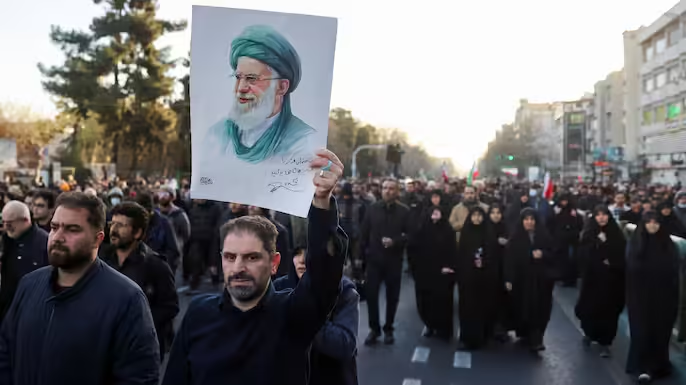
Iran on March 1 officially confirmed that its Supreme Leader, Ali Khamenei,
was killed in coordinated US-Israeli airstrikes, declaring 40 days of national
mourning and signaling a moment of unprecedented upheaval for the Islamic
Republic.
State media reported that Khamenei died on February
28 after large-scale strikes targeted senior leadership compounds and critical
military installations across Iran. A senior Israeli official earlier told
Reuters that his body was recovered from the rubble of his residence following
the bombardment.
US President Donald Trump said Washington
worked “closely” with Israel in the operation, describing it as a direct strike
on the apex of Iran’s power structure. Khamenei, who had ruled since 1989, held
ultimate authority over Iran’s military, judiciary and strategic doctrine.
His killing marks the most dramatic escalation
between Iran, the United States and Israel in decades — a development that
threatens to redraw the security landscape of West Asia and raises the spectre
of rapid retaliation.
Shock, celebration and fear
The announcement of Khamenei’s death produced
starkly contrasting scenes inside Iran.
In parts of Tehran, Karaj and Isfahan, small
groups gathered in visible celebration, with unverified videos on social media
showing similar reactions elsewhere. For some, the death of a leader who had
dominated Iranian politics for over three decades marked the end of an era.
But jubilation in pockets was overshadowed by
fear. The scale of the overnight bombardment left many residents shaken.
“We are scared, we are terrified. My children
are shaking, we have nowhere to go,” Minou, a 32-year-old mother in Tabriz,
told Reuters, reflecting widespread anxiety about what may follow.
A system under sudden strain
The assassination of Ali Khamenei has thrust Iran into its most serious
political crisis since the 1979 revolution led by Ruhollah Khomeini.
Iran’s constitutional framework provides a
mechanism to appoint a new supreme leader under the doctrine of vilayat-e faqih —
guardianship of the Islamic jurist — which mandates that ultimate authority
rests with a senior Shi’ite cleric until the return of the hidden 12th Imam.
Yet the system has never before been forced to
execute a leadership transition under direct foreign military attack.
Khamenei governed through a tightly controlled
inner circle of clerics and security chiefs. Saturday’s strikes reportedly
killed several senior figures, raising urgent questions about how intact that
command structure remains.
Analysts have previously mentioned possible
successors, including Mojtaba Khamenei, the late leader’s son, and Hassan Khomeini, grandson of the republic’s
founder. However, no figure currently commands the same religious authority or
institutional dominance that Khamenei wielded — particularly over powerful
entities such as the Islamic Revolutionary Guard Corps.
As Iran begins a 40-day mourning period, it faces not only grief but a defining test of political continuity. The region, meanwhile, braces for the possibility that this strike — unprecedented in scale and symbolism — could trigger a far wider confrontation.