Missiles over the Gulf, fear in Indian homes: 10 million diaspora confront war’s shadow
By | International | 02-Mar-2026 10:30:04
News Story
For nearly 10 million Indians whose lives and livelihoods are rooted in West Asia, the escalating conflict following US and Israeli strikes on Iran has turned into a waking nightmare.
Missiles streak across Gulf skies. Interceptor blasts light up the night. Mobile phones buzz relentlessly — alerts, rumours, frantic calls from “back home”. Across Indian towns and villages, daily life has been replaced by dread, with families glued to screens, waiting for reassurance that loved ones are safe.
In Laila village of Karnataka’s Dakshina Kannada district, 56-year-old Asiya says she could not breathe easy until her sons — one in Abu Dhabi, the other in Bahrain — called her. “When I heard about the attacks, I started praying immediately. Only after they said they were safe did I feel relief,” she says.
In Dubai, industrialist and philanthropist S P Singh Oberoi describes a skyline transformed by war. “Drones and missiles are clearly visible in the sky. Debris is falling in some areas and has caused losses,” he says, calling the situation tense but controlled.
The Indian presence in the region is vast and deeply interwoven with India’s economy. More than nine million Indians reside across the Gulf Cooperation Council (GCC) countries alone, concentrated heavily in the United Arab Emirates and Saudi Arabia.
Government data also records over 100,000 Indians in Israel and more than 10,000 in Iran, alongside thousands of students across the region.
The Gulf is not only home — it is lifeline. According to the Reserve Bank of India’s Remittances Survey 2025, inward remittances touched $118.7 billion in 2023–24. The UAE accounted for 19.2 per cent of that inflow, second only to the United States.
Saudi Arabia, Qatar, Kuwait and Oman followed among the top contributors — underscoring how deeply India’s financial stability is tied to Gulf stability.
In the UAE alone, Indians form the largest expatriate community, making up roughly 35 per cent of the population. An estimated 4.3 million Indian nationals reside there, spread across Abu Dhabi, Dubai and other emirates. Kerala leads in representation, followed by Tamil Nadu, Andhra Pradesh, Telangana, Uttar Pradesh, Bihar and Punjab.
But as Iranian drone and missile strikes reportedly targeted airports and strategic sites in the region, the conflict spilled into civilian life. Major aviation hubs in Dubai, Abu Dhabi and Doha have faced closures and disruptions.
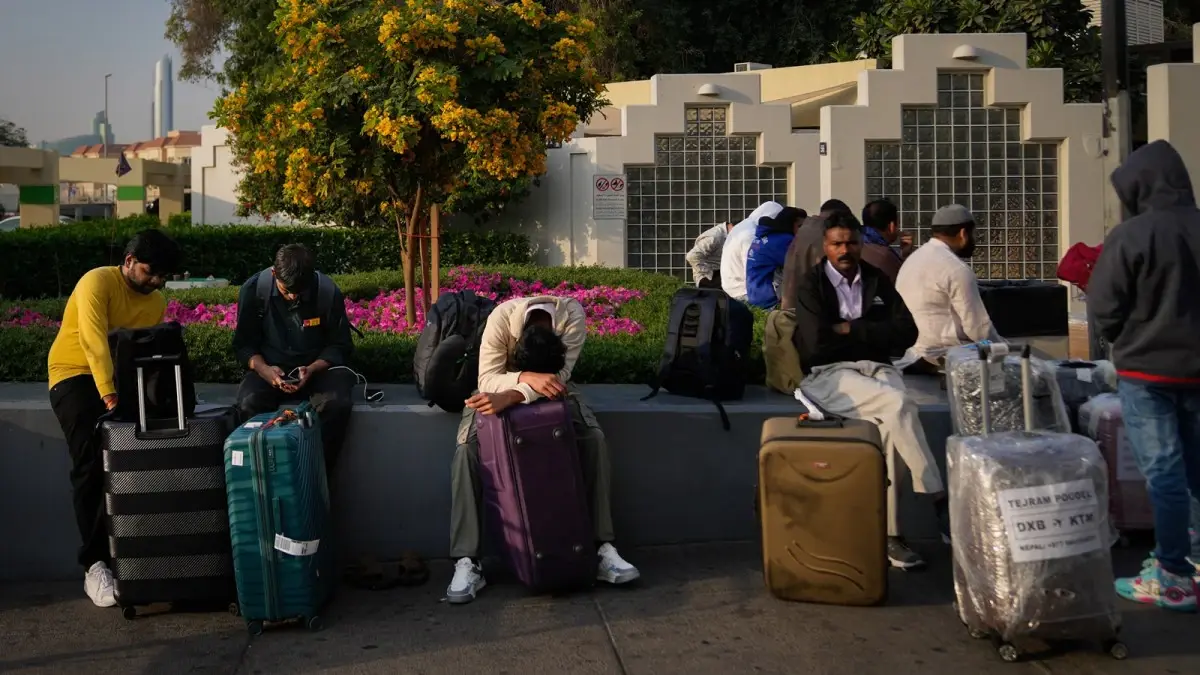
Over 1,000 flights were cancelled, stranding tens of thousands of passengers. At least four injuries were reported at Dubai International Airport after debris from intercepted projectiles fell near the facility.
Oberoi says authorities have advised residents not to step out “unless absolutely necessary”. His organisation, Sarbat Da Bhala, is assisting stranded travellers despite movement restrictions. “We are accommodating several people. The government is cooperative. We have faced Covid before — we will overcome this too. People must remain calm,” he says. Yet calm is fragile.
Badruddin Azman, an HR professional from Dakshina Kannada based in Dubai, says misinformation is compounding fear. “Parents back home are panicking because of WhatsApp forwards and unverified videos.
The misinformation is worse there than here,” he says. Schools have shifted to remote learning until March 4, and residents have been told to stay indoors due to falling debris from intercepted missiles.
In Abu Dhabi, Mohammed Adam and Akbar Ali recall “the scare of our lives” when sirens warned of incoming missiles. “We ran inside our homes fearing residential buildings could be targeted. It was a tough night — loud explosions as missiles were intercepted,” Adam says.
Elsewhere, the crisis has left many suspended in transit. Deendayal Shetty, scheduled to return to Dubai from Bengaluru, now faces uncertainty as airspace closures extend. “I don’t know how long this will continue. I had to be back this week — that seems unlikely,” he says.
In Manama, Bahrain’s capital, a trader from Thiruvananthapuram describes repeated blasts and heightened alert. The Juffair area, reportedly struck by missiles, remains closed. Authorities have urged residents and expatriates alike to move to shelters when alerts sound. “Food is available, but not all shops are open. People are panicking mainly because several places were hit,” he says.
For millions of Indians in the Gulf — and millions more waiting anxiously in India — the conflict is no longer distant geopolitics. It is the sound of sirens at midnight. It is falling debris. It is cancelled flights. It is children logging into online classes while parents watch the sky.
Above all, it is the fragile thread of a phone call — the only reassurance that, for now, they are still safe.