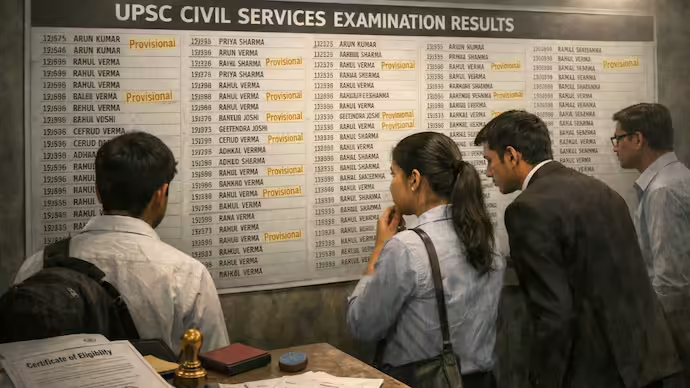
Provisional tag puts 348 UPSC 2025 candidates under scrutiny before final appointment
By | Career | 07-Mar-2026 11:16:48
News Story
Even as the UPSC Civil Services Examination
2025 results recommended 958
candidates for appointment to India’s premier civil services, 348 of them have been placed under provisional
status, meaning their candidature is subject to further verification
before final confirmation.
The provisional tag indicates that certain documents or eligibility claims submitted by
candidates are yet to be fully verified by the Union Public Service Commission
(UPSC). Until this process is completed, the candidates remain in the
merit list but their appointments are not formally confirmed.
For many aspirants studying the result
notification closely, the term “provisional” often raises concerns about
whether their selection could be affected. In most cases, however, the status
is part of a routine administrative procedure carried out after the results are
announced.
What
provisional status means
A provisional result generally signifies that
authorities still need to verify certain details provided by candidates during
the examination process.
These checks typically involve scrutiny of
documents such as:
·
Category certificates for SC, ST, OBC, and EWS candidates
·
Disability certificates under Persons with Benchmark Disabilities (PwBD)
categories
·
Educational qualification records
·
Other eligibility documents submitted during the
application process
Once these documents are verified and found to
be valid, the provisional status is usually removed and the candidature is
confirmed.
Why
the verification process matters
The UPSC
Civil Services Examination, widely regarded as one of India’s most
competitive recruitment processes, requires multiple levels of scrutiny before
appointments are finalised.
Since candidates apply under different
reservation categories and eligibility criteria, each claim must be formally verified before the
government issues appointment orders. This step ensures that service allocation and reservation benefits are
granted accurately and transparently.
Officials emphasise that the provisional tag does not reflect negatively on a candidate’s
performance, but serves as a temporary administrative marker until the
verification process is complete.
Category
distribution in the final list
Among the 958 candidates recommended by the UPSC, the
category-wise distribution is:
|
Category |
Number of candidates |
|
General |
317 |
|
EWS |
104 |
|
OBC |
306 |
|
SC |
158 |
|
ST |
73 |
|
Total |
958 |
The list also includes candidates from various
PwBD categories, reflecting the
reservation framework within civil services recruitment.
|
PwBD category |
Candidates |
|
PwBD-1 |
10 |
|
PwBD-2 |
14 |
|
PwBD-3 |
9 |
|
PwBD-5 |
9 |
Because reservation plays a critical role in
civil service appointments, verification
of category certificates becomes a key step after the result
declaration.
Reserve
list prepared for future vacancies
Along with the main merit list, the UPSC has also prepared a reserve list of 258 candidates.
This list is used to fill vacancies that may
arise later due to circumstances such as:
·
candidates declining the service offered
·
documentation or eligibility issues
·
failure to meet verification requirements
·
withdrawal after service allocation
If such situations arise, candidates from the
reserve list may be recommended subsequently, giving them a second opportunity
to enter the civil services.
Two
results withheld
The commission has also withheld the results of two candidates,
though it did not specify the reasons in its press note.
Such cases are not uncommon in large
recruitment examinations and are often linked to pending verification, documentation issues, court cases, or
administrative review. Once the matter is resolved, the results may be
declared separately.
What
happens next
Following the declaration of the merit list,
several administrative steps remain before candidates formally join the
services.
These include:
·
verification of documents and eligibility claims
·
final confirmation of candidature
·
service allocation based on rank and preferences
·
cadre allocation for services such as Indian Administrative Service and Indian Police Service
Only after these stages are completed do
successful candidates proceed to training as civil servants.
For thousands of aspirants analysing the
results each year, the process highlights that clearing the examination is only part of the journey—final
appointments depend on multiple administrative checks and allocations that
follow the result declaration.