Education exports can power India’s global rise: Piyush Goyal
By | International | 07-Mar-2026 12:09:41
News Story
Union Commerce and Industry Minister Piyush
Goyal recently said education as a service holds immense potential to
boost India’s export earnings while expanding the global reach of the country’s
higher education institutions.
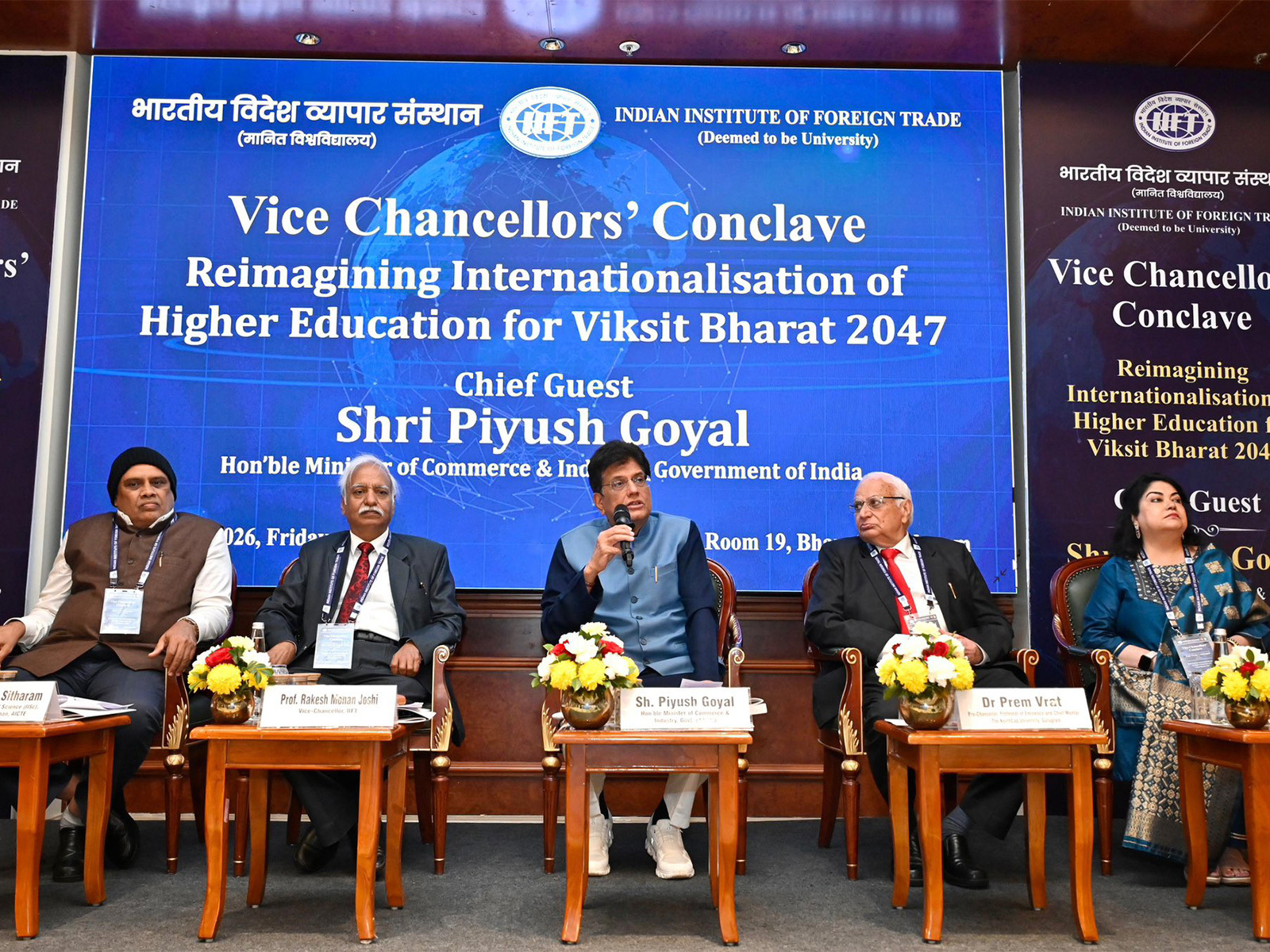
Speaking at the Vice Chancellors’ Conclave on “Reimagining Internationalisation of Higher
Education for Viksit Bharat 2047”, Goyal said India must leverage its
academic strengths to position itself as a major destination for global
students.
The conclave, organized by the Indian Institute of Foreign Trade (IIFT) under
the Ministry of Commerce, brought together academic leaders and policymakers to
explore strategies for internationalising higher education. Discussions focused
on global partnerships, student mobility, regulatory reforms and dual-degree
programmes aimed at strengthening the global competitiveness of Indian
universities.
Goyal said emerging global trends indicate
that future growth engines will increasingly be developing economies such as India. As a result, students from developed
nations will benefit from exposure to India and its evolving economic and
social landscape.
The minister said this shift is already
visible in negotiations over services chapters in India’s Free Trade
Agreements. According to him, the nine FTAs concluded under the government led
by Prime Minister Narendra Modi have
largely been with developed economies, helping expand India’s integration with
global trade networks.
“India no longer negotiates from a position of
weakness or a colonial mindset,” Goyal said, adding that the country now
engages with the world confidently and from a position of strength.
Highlighting India’s role in the global
economy, he noted that the country currently contributes nearly 20 per cent of
global growth. In the coming decades, he said, young professionals across the
world will increasingly need to engage with fast-growing economies such as
India.
Goyal credited the transformation of the
education sector to the National Education Policy
2020, which he said was drafted after extensive consultations with
educators and stakeholders across the country and abroad. Nearly three lakh
suggestions were examined before the policy was finalized.
The policy, he said, has opened India’s
education system to international collaboration, allowing foreign universities
to establish campuses in India, enabling joint and dual-degree programmes, and
promoting cross-border student exchanges.
He suggested innovative academic models to
attract international students, such as programmes where students spend part of
their study period in India and the rest at their home institutions. Such
arrangements, he said, would give students deeper exposure to the thinking,
culture and economic dynamics of developing countries.
Addressing Vice Chancellors at the conclave,
Goyal described them as “architects of India’s future” responsible for shaping
the next generation. He stressed that universities must constantly evolve with
changing global trends and that teachers must undergo continuous retraining to
remain aligned with modern curricula and emerging knowledge systems.
“Students cannot be prepared for the future
through outdated curricula,” he said, urging institutions to adopt agile
academic frameworks and anticipate emerging opportunities.
The minister also emphasized the growing
importance of advanced technologies such as artificial intelligence, quantum
computing and machine learning for India’s economic future. Educational
institutions, he said, must update curricula to reflect these shifts while also
introducing subjects related to international trade and India’s Free Trade
Agreements.
Goyal expressed confidence that such reforms
would eventually reverse the current trend of large numbers of Indian students
studying abroad. At present, around 28 Indian students leave the country for
higher education for every one foreign student studying in India.
He said the goal should be to turn India into
a major global education destination, attracting around 1.3 million
international students while significantly reducing outbound student migration.
Calling for stronger collaboration between academia, government and industry, the minister said such partnerships would be critical to internationalizing India’s higher education system and realizing the vision of a developed India by 2047.