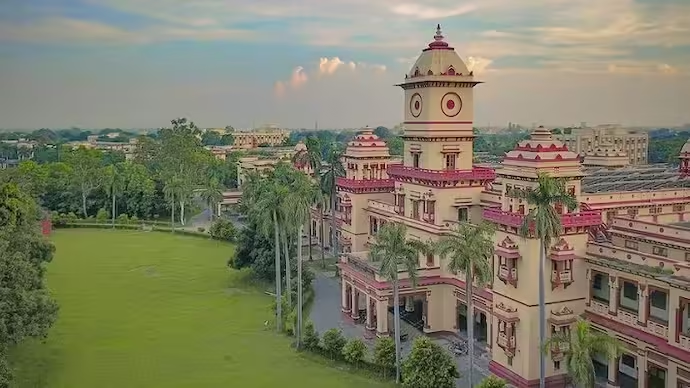
BHU: Asia’s largest residential University built on a 1,300-acre campus in UP
By | Education | 13-Mar-2026 16:27:45
News Story
More than a century ago, an ambitious educational project began in the
ancient city of Varanasi — one of the world’s
oldest continuously inhabited urban centres. The institution was conceived
during colonial rule to create a generation of Indians grounded in their civilizational
values while equipped with modern knowledge.
Today, that institution — Banaras Hindu University (BHU) — spans over 1,300 acres and functions like a
self-contained academic town, with hostels, lecture halls, libraries and
research centres spread along wide tree-lined roads.
The
early vision
The intellectual roots of BHU trace back to
education reformer Annie Besant, who
founded the Central Hindu College
in 1898 in Banaras. She believed
that India’s education system needed to combine modern academic subjects with
the country’s philosophical and cultural traditions.
The college initially started in a rented
building but soon shifted to a larger campus in Kamachha after land was donated
by local ruler Maharaja Prabhu Narayan Singh.
Over time, the institution developed into a major centre of learning,
attracting students and scholars from across India.
Besant also promoted women’s education by
establishing the Central Hindu Girls’
School in 1904, further
expanding the educational network in the area.
From
colleges to a national university
The idea of transforming these institutions
into a major university took shape when Besant joined hands with nationalist
leader Madan Mohan Malaviya.
Malaviya envisioned a large modern university
where students could study science, technology, humanities and traditional
Indian knowledge under one roof.
After years of advocacy, the Banaras Hindu University Act 1915 paved
the way for the university’s creation. In 1916, its foundation was formally laid by the then
Viceroy of India, Lord Hardinge.
A
university that became a city
Over the decades, BHU expanded into one of
India’s largest academic institutions. Its residential model — where students
and teachers live and study within the campus — contributed to its vast scale.
Today, the campus extends across 11 villages, making Banaras Hindu University not just a university but a sprawling academic city — a lasting legacy of a nationalist effort to reshape education in India.