Marks as resistance: Rajasthan girls top exams to stay in school and delay early marriage
By | Education | 26-Mar-2026 11:06:07
News Story
The latest RBSE results are out, and once again, girls have outperformed
boys across Classes 5, 8 and 10 — continuing a streak that has now stretched to
seven consecutive years in Class 10.
This year, a farmer’s daughter secured a near-perfect 599 out of 600 to
top the state. On the surface, it reads like a familiar story of academic
excellence. But in Rajasthan, these results are rarely just about ranks.
They are about survival, negotiation and resistance.
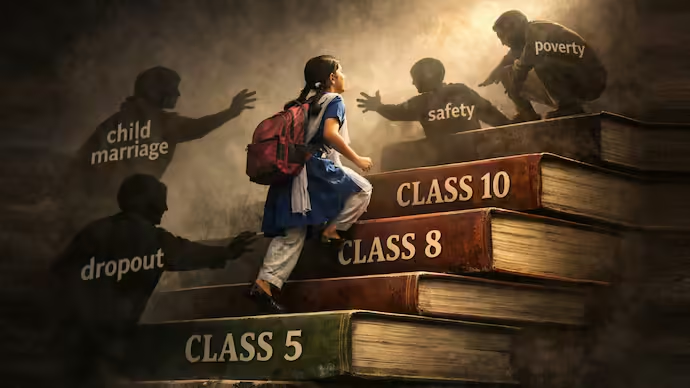
For many girls, a marksheet is more than a record of performance — it is
leverage. A strong score can mean the difference between continuing education
and being pulled out of school, between delaying marriage and having it fixed
early.
In Rajasthan, merit often doubles as a shield.
A fight that begins before birth
The barriers girls face start long before they enter classrooms.
NFHS-5 (2019–21) data shows Rajasthan’s sex ratio at birth stands at 888
girls per 1,000 boys, reflecting a persistent preference for sons. The figure
places it alongside Haryana (889) and below Gujarat’s improving 955. Even Uttar
Pradesh reports a higher overall sex ratio of around 1,017 females per 1,000
males.
In 2019 alone, 36 cases of female infanticide were reported in the state
— a reminder that for some, the struggle begins even before birth.
Structural gaps and everyday
barriers
While literacy has improved, gender gaps remain stark, especially in
rural areas.
National surveys highlight a pattern:
- High child
marriage prevalence
- Low female
workforce participation
- Rising
crimes against women and children
- Increasing
dropout rates after primary school
Compared to states such as Kerala, Tamil Nadu and Himachal Pradesh,
Rajasthan continues to lag on key indicators of girls’ education and autonomy.
It is within this landscape that girls walk into exam halls — carrying
not just books, but expectations and constraints.
Child marriage still shapes
futures
By adolescence, the pressure intensifies.
NFHS-5 data shows 25.4% of women aged 20–24 in Rajasthan were married
before 18 — an improvement from 35.4% earlier, but still significant. States
like West Bengal (41.6%), Bihar (40.8%) and Jharkhand (32.2%) report higher
rates, placing Rajasthan within a high-prevalence group nationally.
In many households, a girl’s academic performance directly influences
decisions about her future. Good marks often translate into permission — to
study further, to wait, to hope.
A strong result can buy time.
The dropout curve tells the real
story
The most critical drop happens after middle school.
UDISE+ 2023–24 data shows girls’ dropout rates in Rajasthan hover around
13–14% at the secondary level, slightly above the national average. At the
upper primary stage, about 5.3% of girls drop out before transitioning further.
The reasons are layered:
- Household
responsibilities
- Safety
concerns
- Lack of
nearby schools
- Financial
strain
- Social
expectations of early marriage
In this context, board exams become a turning point. A high score can
convince families that continued education is worth the investment.
Safety concerns shape education
choices
Decisions around schooling are also shaped by safety.
NCRB 2023 data records over 10,500 cases of crimes against children in
Rajasthan — a sharp 70% increase from the 2018–22 average of around 6,200. The
state ranks fourth nationally in total cases, after Madhya Pradesh, Maharashtra
and Uttar Pradesh.
Between January and June 2024 alone, 794 POCSO cases involving minors
were reported.
These figures influence everyday decisions — whether girls can travel
alone, attend coaching or even continue school beyond a certain level. For many
families, withdrawing girls from school is seen as protection.
For girls, staying enrolled becomes something they must justify.
Progress, but uneven
At the higher education level, the picture shows cautious improvement.
AISHE 2021–22 data places women’s Gross Enrolment Ratio in Rajasthan at
around 28%, close to the national average of 28.4%, with a Gender Parity Index
of 1.01.
This marks a significant rise from about 15–18% a decade ago, aided by
scholarships and state interventions.
Yet, compared to stronger performers like Tamil Nadu and Kerala, the
gains remain uneven. Rajasthan sits in the middle — progressing, but not
leading.
Marriage remains a defining force
Even education does not fully insulate women from social pressures.
NCRB 2022 data shows Rajasthan reported 451 dowry deaths, the fourth
highest in the country after Uttar Pradesh, Bihar and Madhya Pradesh.
The numbers underscore a reality where marriage continues to shape life
trajectories — regardless of education.
Which is why every additional year in school matters.
Why girls keep outperforming
In this context, the consistent academic success of girls takes on a
deeper meaning.
Teachers across Rajasthan often observe a clear pattern: girls who score
well are more likely to stay in school. Those who do not face a higher risk of
being withdrawn.
The stakes are fundamentally different.
For boys, poor marks may limit opportunities.
For girls, they can end education altogether.
This difference drives behavior — higher attendance, discipline and
sustained effort. Girls are not just competing for ranks; they are competing
for continuity.
What the results really reveal
Taken together, the data tells a layered story.
Rajasthan continues to grapple with:
- Skewed sex
ratio at birth
- Significant
child marriage prevalence
- Rising
crimes against children
- Noticeable
dropout rates
- Persistent
dowry-related deaths
At the same time, it shows incremental progress in education access and
participation.
It is within this contradiction that girls are carving space for
themselves.
So when girls top RBSE exams year after year, it is not merely an
academic trend.
It is a quiet assertion of agency.
A way to stay in classrooms longer.
A way to delay decisions made for them.
A way to claim time, voice and possibility.
In Rajasthan, every mark scored by a girl carries weight far beyond the classroom — and that is why they continue to lead.