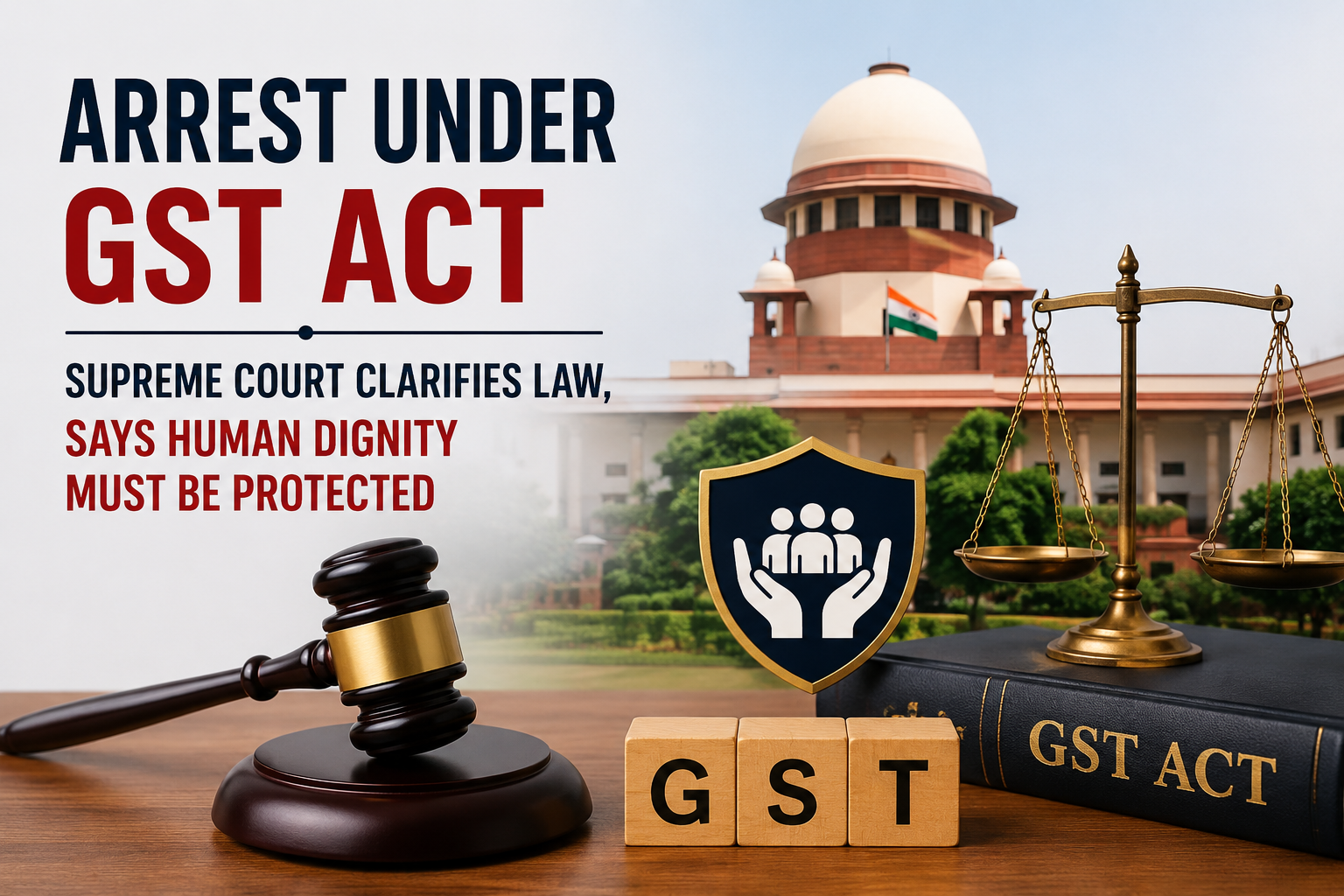
Arrest Under GST Act: Supreme Court Clarifies Law, Says Human Dignity Must Be Protected
By Administrator | National | 13-Jul-2026 13:13:53
News Story
New Delhi: The Supreme Court has reaffirmed that the power to arrest under the Goods and Services Tax (GST) Act must be exercised with fairness, legal justification, and respect for human dignity. In a significant observation, the Court said that enforcement agencies cannot ignore constitutional safeguards while exercising their statutory powers. The ruling makes it clear that although GST authorities have the legal power to arrest in specified cases, such powers must always be exercised responsibly and in accordance with the law.
The Court's observations came while hearing a matter related to the exercise of arrest powers under the GST Act. It emphasized that the authority to arrest is an important legal power, but it cannot be used arbitrarily or without following the procedure established by law. The Court also reiterated that every individual is entitled to dignity and fair treatment, even during an investigation or arrest.
Supreme Court's Observation on GST Arrests
 According to the Supreme Court, an arrest under the GST Act should never become a routine step in every investigation. Authorities must have valid legal reasons and sufficient justification before deciding to arrest an individual.
The Court observed that officers are expected to act fairly, transparently, and within the limits of the law. Simply having the statutory power to arrest does not give authorities unrestricted discretion. Any action that ignores due process or violates constitutional safeguards could affect an individual's fundamental rights.
The Supreme Court further stressed that people under investigation or in custody must be treated with respect. Unnecessary humiliation, harassment, or arbitrary use of power has no place in a legal system that is governed by the Constitution.
Why This Judgment Is Important
 The ruling is significant because it reinforces the balance between effective law enforcement and the protection of individual rights. While GST authorities are empowered to investigate tax evasion and other financial offences, the Court clarified that enforcement should always remain within the boundaries of the Constitution.
The judgment also highlights the importance of due process. Every arrest must be supported by lawful reasons and carried out according to the legal procedure prescribed under the GST Act and other applicable laws.
This clarification is expected to strengthen transparency and accountability in GST investigations while ensuring that constitutional values remain central to the enforcement process.
What It Means for Taxpayers
 For taxpayers, businesses, and professionals, the Supreme Court's observations provide greater clarity about their legal rights during GST investigations. The ruling confirms that arrests cannot be made without proper legal justification and that authorities must follow the due process of law before taking such action.
The judgment also reassures taxpayers that constitutional protections continue to apply throughout an investigation. Every person has the right to fair treatment, respect, and dignity, regardless of the allegations being examined.
At the same time, the Court's observations do not reduce the powers available to GST authorities in genuine cases of tax fraud or serious violations. Instead, the ruling ensures that these powers are exercised responsibly and only in accordance with the law.
Key Highlights of the Judgment
According to the Supreme Court's observations, the following principles should guide arrests under the GST Act:
GST authorities have the legal power to arrest only in cases permitted under the GST Act.
Arrests cannot be made arbitrarily or without proper legal justification.
Officers must strictly follow the procedure established by law.
Every individual has the right to dignity, respect, and fair treatment during an investigation or arrest.
Constitutional safeguards must be respected while exercising statutory powers.
The ruling promotes greater transparency, accountability, and responsible enforcement of GST laws.
Conclusion
The Supreme Court's clarification on arrests under the GST Act is an important reminder that tax enforcement and constitutional rights must go hand in hand. While authorities continue to have the legal power to act against tax evasion and other serious offences, every action must follow due process and uphold the dignity of individuals.
The judgment is expected to serve as an important guiding principle for future GST investigations by encouraging fair, transparent, and legally compliant enforcement. It also reinforces the broader constitutional principle that the rule of law must always be accompanied by respect for the rights and dignity of every individual.