Mohandas Pai’s School Inspection Suggestion Draws Sharp Response From CJP’s Saurav Das
By | Education | 24-Aug-2026 15:07:53
News Story
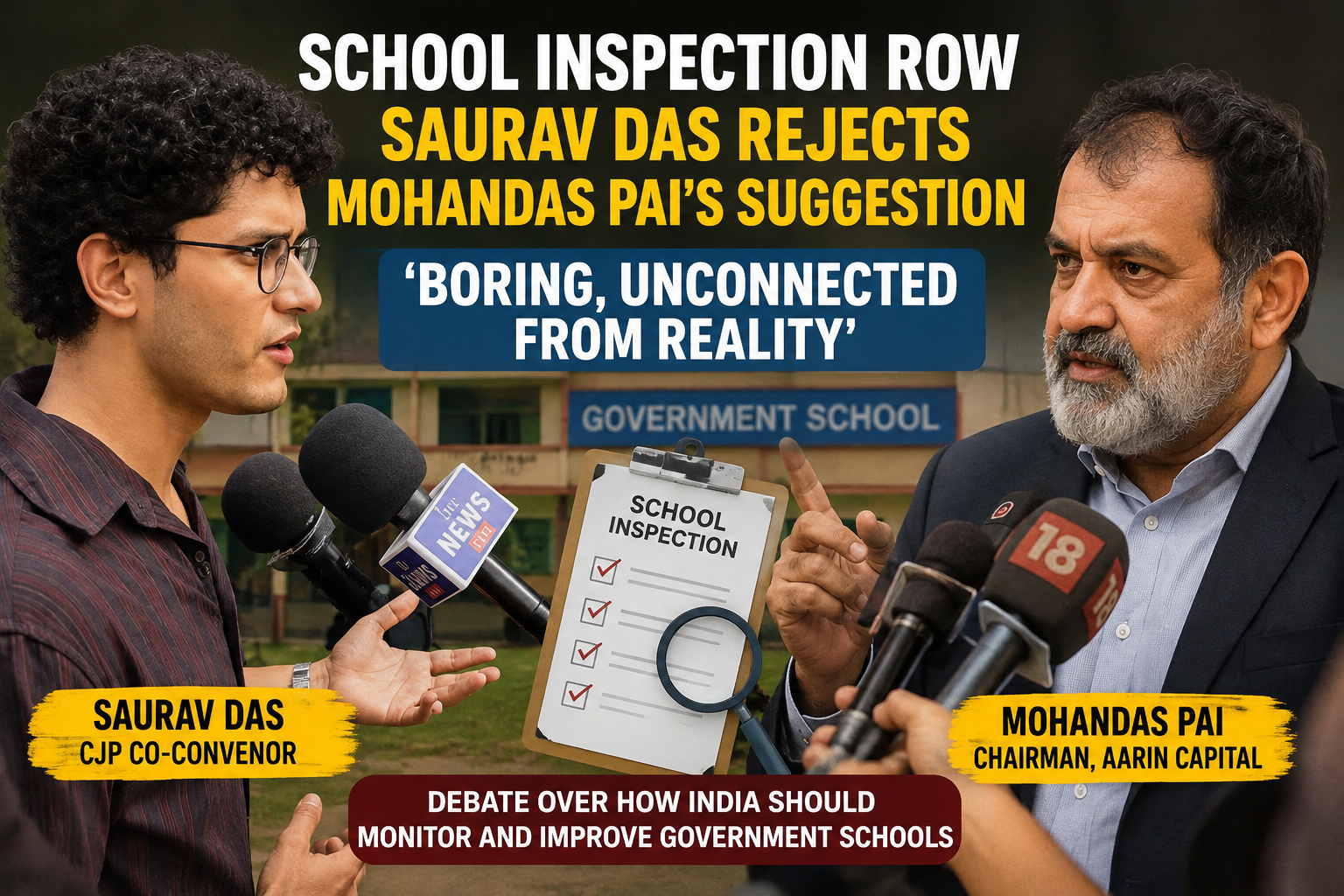
CJP's Saurav Das Rejects Mohandas Pai's School Inspection Suggestion: ‘Boring, Unconnected from Reality’
New Delhi: Cockroach Janta Party (CJP) co-convenor Saurav Das has rejected Aarin Capital Chairman Mohandas Pai's suggestion for conducting structured inspections of government schools, calling the approach “slow, boring, unconnected to reality”. The exchange between the two came amid a controversy surrounding the CJP's ongoing 'School Thik Karo' campaign, which has been highlighting the condition of government schools in different parts of the country.
The disagreement has brought renewed attention to the larger question of how citizens, civil society organisations and governments should assess and address problems in India's school education system.
According to reports, the controversy escalated following an alleged incident involving CJP volunteers during a school inspection in Rajasthan. Pai criticised the manner in which the inspection was conducted and suggested that the campaign should instead adopt a more systematic and permission-based approach.
Das, however, argued that similar exercises are already being undertaken by government institutions and independent organisations, yet problems in government schools continue to exist. He questioned whether another round of formal inspections and reports would be sufficient to bring meaningful change.
Mohandas Pai Suggests Structured School Inspections
Mohandas Pai proposed that CJP volunteers should organise themselves into small groups and conduct school-level inspections across states.
According to his suggestion, volunteers should work in groups of two, visit schools allocated to them after obtaining appropriate permission, inspect facilities and prepare detailed reports on the situation at the local level. The reports could then be submitted to state governments.
Pai also suggested that the organisation should publish quarterly reports and engage with citizens using verified data. According to him, collecting systematic information would help identify states and regions where the situation requires greater attention.
Pai also highlighted the scale of India's school education system, pointing to the large number of schools, students and teaching and non-teaching staff involved. He argued that a data-driven approach could help build stronger public pressure for improvements in school infrastructure and administration.
The suggestion came after Pai criticised the reported involvement of a large group of people in a school visit. He argued that the safety and security of students should remain the priority when outsiders enter educational institutions.
Pai's position was that a small number of volunteers should visit schools, interact respectfully with relevant people and conduct a proper assessment rather than turning school inspections into confrontational public events.
Saurav Das Calls the Approach ‘Slow and Boring’
Responding to Pai, Saurav Das questioned whether the proposed process would be effective in addressing problems that have persisted for years.
Das said that similar work is already being carried out by NITI Aayog and independent NGOs, but the problems highlighted by CJP continue to be visible on the ground.
He questioned the practicality of sending groups of two volunteers to schools in areas where obtaining permissions could itself become a hurdle.
“Whatever you are saying is being done by both the NITI Aayog and independent NGOs. Yet you see what you see,” Das said in a social media post.
He then described Pai's suggestion as “slow, boring, unconnected to reality”, adding that it was “much like the present system”.
The statement reflects the fundamental difference between the two approaches. While Pai has emphasised systematic data collection, permission and institutional engagement, Das has defended a more direct citizen-led approach aimed at bringing immediate public attention to problems in schools.
Dispute Began After Rajasthan School Inspection Incident
The exchange between the two followed reports of an alleged confrontation involving CJP volunteers in Jaipur, Rajasthan.
CJP members had reportedly gone to inspect a government school after concerns were raised about the condition of the institution and the premises being used for schooling. The organisation claimed that its members were confronted and attacked during the visit.
CJP leader Ashutosh Ranka also posted about the alleged incident on social media and claimed that one of the persons involved in the incident had been assaulted.
The allegations triggered criticism and a wider debate over whether citizen groups should directly visit schools without prior institutional coordination.
Pai strongly criticised the reported incident and argued that bringing a large group to a school containing young children could create a security concern.
He maintained that villagers and parents have a legitimate interest in protecting children and that outside groups should not enter educational premises in a manner that could cause fear or disruption.
The CJP, on the other hand, has argued that citizens have a legitimate interest in examining the condition of public institutions, particularly government schools that are funded through public resources.
‘School Thik Karo’ Campaign Puts Government Schools Under Spotlight
The disagreement is taking place against the backdrop of CJP's 'School Thik Karo' campaign, through which the organisation has been drawing attention to infrastructure and basic facility-related issues in government schools.
The campaign has focused on issues such as school buildings, toilets, drinking water, classrooms and other basic facilities. Volunteers have been sharing photographs and information from schools to draw public attention to their condition.
The campaign's supporters argue that publicly documenting problems can create pressure on authorities to act.
The approach is different from conventional government inspection mechanisms, which generally involve official surveys, administrative reports and departmental monitoring.
CJP's position is that merely having data about school infrastructure is not enough if problems identified through such data remain unresolved.
Debate Over Data vs Ground-Level Action
At the heart of the disagreement between Pai and Das is a larger debate over data-driven monitoring versus direct public intervention.
Pai's proposed model focuses on creating reliable, structured and comparable information. If volunteers inspect schools using a common methodology, compile reports and publish them periodically, it could potentially provide a clearer picture of infrastructure gaps across different regions.
Such an approach could also make it easier to compare districts and states and identify areas requiring immediate intervention.
Das's criticism, however, highlights another concern: India already has several government departments, surveys and organisations collecting information about schools. If the data already exists but schools continue to face infrastructure problems, simply producing another report may not necessarily solve the underlying issue.
The CJP approach therefore appears to place greater emphasis on visibility, public pressure and immediate attention to specific schools.
Both approaches have potential strengths as well as limitations.
Why School Inspections Require Careful Coordination
School inspections involving outside groups also raise practical questions related to student safety, privacy and disruption of academic activities.
Schools are environments where children, teachers and administrative staff are present. Any external inspection therefore needs to ensure that students are not disturbed and that photographs, videos or personal information are handled responsibly.
Obtaining permission and coordinating with school authorities can help reduce misunderstandings and ensure that inspections are conducted safely.
At the same time, excessive procedural restrictions could make independent monitoring difficult, particularly when concerns relate to the functioning of public institutions.
The challenge, therefore, lies in creating a system where independent citizens and organisations can raise legitimate concerns while also respecting the safety, privacy and functioning of schools.
Public Pressure Can Push Authorities to Respond
The controversy also highlights the potential role of citizen campaigns in forcing authorities to respond to infrastructure-related concerns.
CJP has claimed that its campaign has helped bring attention to schools that require repairs or improvements. In one recent development, the organisation claimed that authorities ordered repairs to a school in Rajasthan after the issue was highlighted.
However, such claims need to be assessed independently, and long-term improvement ultimately depends on government agencies implementing and monitoring the required work.
Public campaigns can bring visibility to problems, but sustainable improvements require funding, administrative action, regular inspections and accountability.
A Larger Question for India's School Education System
The exchange between Saurav Das and Mohandas Pai goes beyond a disagreement between two individuals. It reflects a broader question about how India's education system should respond when basic facilities in government schools remain inadequate.
One side argues for structured inspections, reliable data, formal permissions and regular reporting. The other believes that these mechanisms have existed for years and that citizens need to directly highlight problems that remain unresolved.
The most effective solution could potentially involve elements of both approaches. Independent citizens and organisations can document problems from the ground, while governments can use verified data and formal monitoring systems to address them systematically.
For students and parents, the ultimate objective is not whether an inspection is conducted through a campaign or an official process. What matters is whether schools have safe buildings, functional toilets, clean drinking water, adequate classrooms, trained teachers and an environment where children can learn safely.
The ongoing exchange between Das and Pai has therefore brought an important issue back into public discussion: how can India move from identifying problems in government schools to actually fixing them?
As the debate continues, the condition of schools on the ground—and the response of authorities to those concerns—will remain the most important measure of whether such campaigns and inspection mechanisms are producing meaningful results.