IIT Delhi Student Death Sparks Protests: Growing Concerns Over Mental Health and Campus Support
By Administrator | Education | 26-Aug-2026 14:05:35
News Story
IIT Delhi Student Death Sparks Protests: Growing Concerns Over Mental Health and Campus Support
New Delhi: The death of a 31-year-old M.Sc. Physics student at the Indian Institute of Technology (IIT) Delhi has triggered protests on campus and renewed concerns over student mental health, academic pressure and the effectiveness of institutional support systems.
The student, identified as Rishikesh Kumar, died on August 22, 2026, following an incident at the IIT Delhi campus. Police are investigating the circumstances surrounding his death, while students have raised questions about whether adequate support was available to him during a period of mental health difficulties.
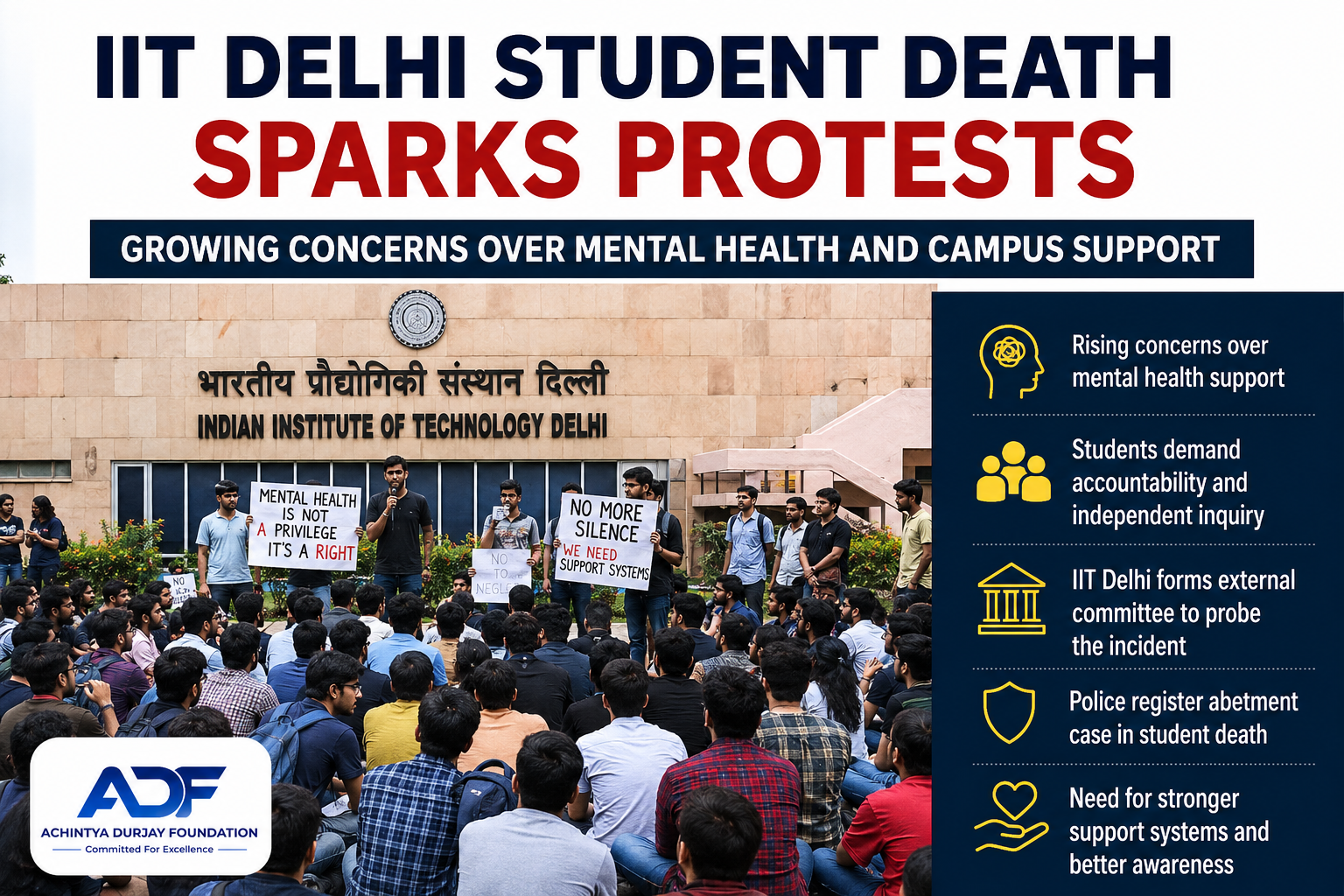
The incident has led to an unusual wave of student mobilisation at one of India's premier technical institutions. Students have demanded greater accountability, an independent inquiry and changes in the way mental health and student welfare concerns are handled.
IIT Delhi Student Death Triggers Campus Protests
The incident has sparked protests involving hundreds of students. Demonstrations began after Kumar's death, with students demanding answers from the institute administration.
According to reports, students have raised concerns not only about the individual incident but also about what they describe as broader problems related to academic pressure, administrative communication and student welfare.
The protests are significant because large-scale student demonstrations are relatively uncommon at IIT Delhi. Students have called for an independent investigation into the circumstances surrounding Kumar's death and have sought accountability from officials responsible for student welfare.
Students Raise Questions Over Institutional Support
Students participating in the protests have alleged that the institute's existing systems were not sufficient to address the difficulties faced by students experiencing serious distress.
Some protesters have also referred to previous student deaths and argued that the issue should not be treated as an isolated incident.
According to reports, students have cited eight alleged suicides at IIT Delhi since 2023, although the circumstances of individual cases can differ and should be assessed separately through official investigations.
What Happened to the IIT Delhi M.Sc. Student?
Rishikesh Kumar was pursuing an M.Sc. in Physics at IIT Delhi. Police said the incident occurred on August 22 on the institute's campus.
Investigators have been examining available evidence, including the student's phone and counselling-related records. Police have also been looking into the circumstances surrounding his death.
At this stage, it is important not to assume a single cause or attribute the death solely to academic pressure or mental health concerns. The investigation is expected to establish the circumstances and whether any institutional or individual responsibility was involved.
Family Raises Allegations of Lack of Support
The student's family has made serious allegations regarding the support he received after experiencing mental health difficulties.
According to media reports, his brother alleged that the family had approached IIT Delhi authorities regarding accommodation and other forms of assistance after Kumar returned to the institute following a medical break.
The family has also raised questions about his academic situation and the assistance available to him.
These remain allegations, and the investigation and any independent inquiry will be important in determining what happened and whether institutional procedures were properly followed.
Mental Health Concerns at IIT Delhi
The latest incident has once again placed the issue of mental health among IIT students in the spotlight.
Students at premier institutions often face intense academic competition, demanding coursework, research pressure, examinations and expectations surrounding career progression. However, mental health concerns can be influenced by several factors, including personal circumstances, social isolation, financial concerns, family difficulties and academic challenges.
IIT Delhi itself has previously acknowledged that mental wellness is an important concern for students.
In a 2025 statement, the institute said it had taken several steps concerning student mental health and welfare and had engaged with students to understand their concerns. The institute also referred to factors such as a competitive environment, coaching culture and social pressures as issues that can affect student well-being.
Why Mental Health Support Matters on College Campuses
A counselling system is most effective when students feel comfortable approaching it before a crisis develops.
Institutions therefore need to look beyond simply providing counselling appointments. A comprehensive student-support system can include:
Easily accessible professional counselling
Confidential mental health services
Peer-support programmes
Academic mentoring
Faculty training to identify warning signs
Flexible academic policies during difficult periods
Stronger communication between students and administration
Emergency support mechanisms
Building a Culture Where Students Can Ask for Help
One of the biggest challenges is reducing the stigma associated with seeking mental health support.
Students may hesitate to approach counsellors because they fear being judged, academically disadvantaged or treated differently by peers and faculty members.
Colleges can address this by making mental health support a normal part of student welfare rather than something associated only with severe psychological distress.
IIT Delhi Forms External Inquiry Committee
Following the student protests, IIT Delhi constituted an external inquiry committee to examine the circumstances surrounding Kumar's death.
The move came amid demands from students for an independent investigation and greater transparency.
Reports indicate that the committee is expected to examine the circumstances surrounding the incident and concerns raised by students and the family.
Why an Independent Inquiry Is Important
An independent inquiry can help establish facts separately from speculation and social media discussions.
It can examine questions such as:
Whether existing student welfare procedures were followed
Whether relevant concerns were communicated to appropriate officials
Whether students facing serious difficulties could access support
Whether accommodation and academic policies were applied appropriately
Whether improvements are required in existing institutional systems
The objective should be to establish facts and identify areas where systems can be strengthened rather than relying on assumptions.
Police Register Abetment Case
The matter has also taken a legal turn. Delhi Police have registered a case of abetment to suicide against unidentified persons in connection with Kumar's death.
The registration of a case does not by itself establish guilt. Investigators will need to examine evidence and determine whether any individual or institutional action contributed to the circumstances surrounding the death.
This legal investigation is separate from the institute's internal or external inquiry and may provide another route for establishing accountability if evidence supports such action.
Student Protests Demand Accountability
The protests at IIT Delhi have focused on several demands, including an independent inquiry, accountability of officials and improvements in student welfare mechanisms.
Students have also called attention to concerns surrounding academic projects, accommodation and mental health support.
Protest Highlights Wider Conversation About Student Well-Being
The situation has raised a broader question for higher education institutions across India: Are academic systems keeping pace with the mental health needs of students?
Premier institutes attract students who have already experienced highly competitive academic environments. Once admitted, they may face another layer of competition, research expectations and career uncertainty.
Academic excellence should therefore be accompanied by systems that allow students to seek help without fear.
What IITs and Universities Can Do to Improve Student Mental Health
The incident provides an opportunity for educational institutions to review their student-support systems.
1. Make Counselling Easily Accessible
Students should be able to contact qualified mental health professionals without complicated procedures or long waiting periods.
2. Strengthen Confidentiality
Students need confidence that seeking counselling will not automatically affect their academic standing or reputation.
3. Improve Faculty Awareness
Professors, supervisors and wardens often interact with students regularly. Training them to recognise signs of serious distress can help institutions respond earlier.
4. Provide Academic Flexibility
Students experiencing significant personal or mental health difficulties may require temporary academic adjustments, leaves or alternative arrangements.
5. Create Stronger Peer Networks
Peer-support initiatives can help students feel less isolated and encourage them to seek professional assistance when required.
6. Review Institutional Policies
Universities should periodically review policies related to hostel accommodation, academic withdrawal, project allocation and student welfare to ensure that vulnerable students are not unintentionally excluded from essential support.
A Larger Lesson for India's Higher Education System
The IIT Delhi incident is not only about one institution. It highlights a wider challenge facing universities and colleges across India.
Academic achievement is important, but the well-being of students must remain an equally important part of higher education.
Students should not feel that asking for help represents failure. Institutions, meanwhile, need systems that respond quickly when students or their families raise serious concerns.
From Crisis Response to Prevention
The most effective mental health strategy is not one that begins after a tragedy. It is one that operates continuously.
Regular student check-ins, accessible counselling, academic mentoring, emergency support and open communication can help institutions identify problems earlier.
Universities should also collect feedback from students about welfare services and publish clear information about how students can seek help.
Conclusion
The death of the IIT Delhi M.Sc. Physics student has triggered an important debate about mental health, academic pressure and institutional accountability in higher education.
While police and the external inquiry committee investigate the circumstances of the case, the concerns raised by students and the family deserve careful examination.
The immediate priority should be establishing the facts and ensuring that students receive appropriate support. In the longer term, IITs and universities across India need to strengthen mental health systems so that students facing personal, academic or emotional difficulties can access help without stigma or fear.
For students experiencing severe emotional distress or thoughts of self-harm, seeking immediate help from a trusted person, qualified mental health professional or emergency service is important. IIT Delhi's official mental health portal lists its Student Counselling Services and emergency support contacts for students.