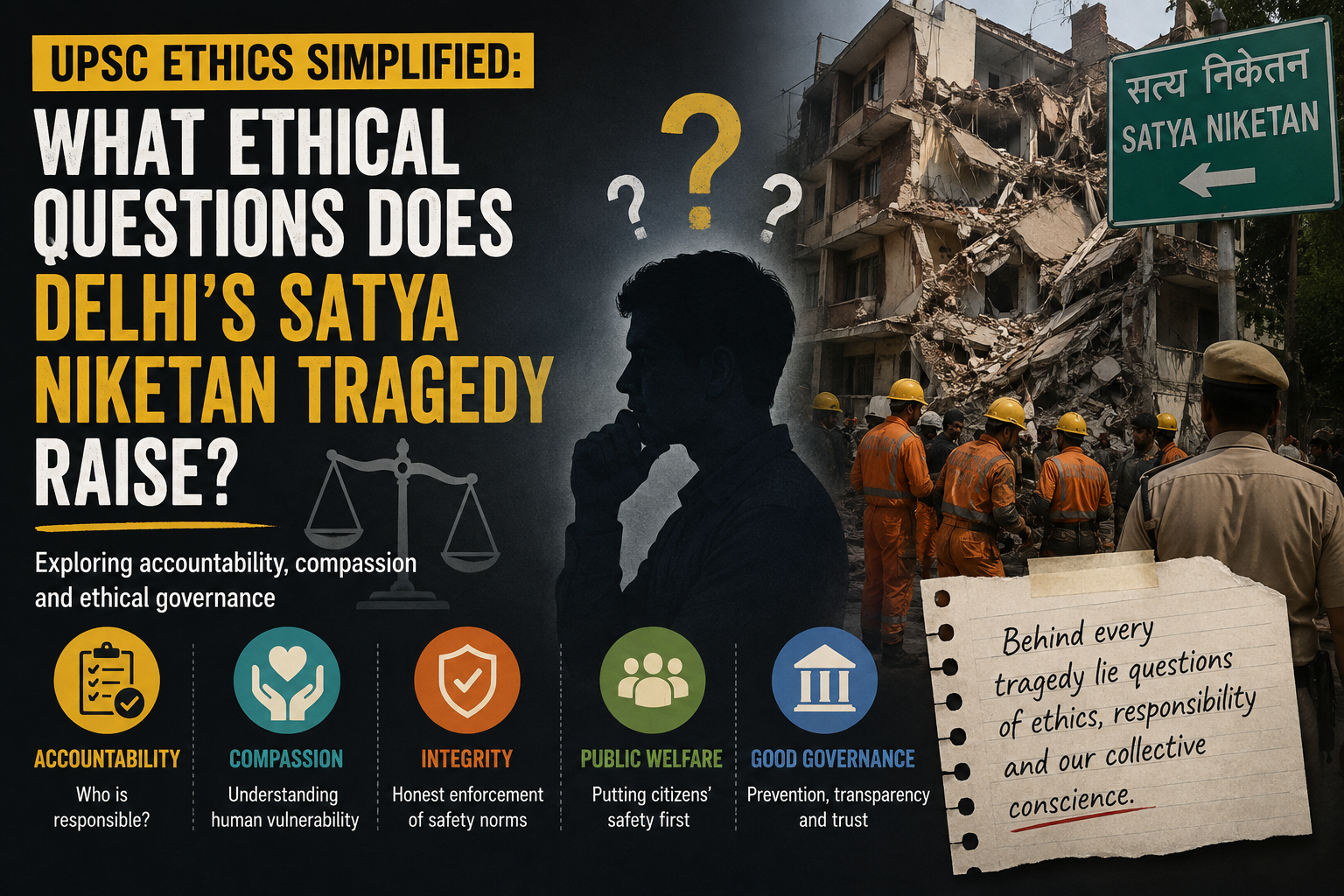
UPSC Ethics Simplified: What Ethical Questions Does Delhi’s Satya Niketan Tragedy Raise?
By Administrator | Education | 16-Sep-2026 13:08:04
News Story
Why the Satya Niketan Tragedy Matters for UPSC Ethics
The Satya Niketan tragedy in Delhi raises important questions about public safety, administrative accountability, ethical governance and the responsibilities of public institutions. Beyond the immediate loss of life, such incidents force us to examine whether existing systems are adequately protecting citizens, especially students and other vulnerable groups living in urban areas.
For UPSC Civil Services Examination aspirants, this incident can be understood as a contemporary case study for General Studies Paper 4, which deals with Ethics, Integrity and Aptitude. It provides an opportunity to connect theoretical values such as compassion, responsibility, integrity and probity with real-life administrative challenges.
The central ethical question is simple yet profound: What is the responsibility of the state and public authorities when citizens are exposed to preventable risks?
1. The Conflict Between Aspirations and Vulnerability
Delhi attracts thousands of students preparing for competitive examinations such as UPSC, SSC, NEET and JEE. Many of them come from different parts of the country with limited financial resources. Affordable accommodation is therefore an important part of their educational journey.
When students are forced to choose between expensive accommodation and potentially unsafe housing, their freedom of choice becomes a matter of ethical concern.
This raises an important question:
Can a choice be considered truly free when safe and affordable alternatives are not available?
This situation can be understood through the concept of vulnerability. Economically weaker individuals may have fewer options and may be more exposed to unsafe living conditions.
From an ethical perspective, public administration must recognize the special needs of vulnerable citizens. Governance should not merely assume that every individual has equal bargaining power or access to safe alternatives.
2. Administrative Accountability: Who Is Responsible?
One of the most important ethical questions raised by building-related tragedies is administrative accountability.
Building safety involves multiple stakeholders, including property owners, construction authorities, municipal bodies and other regulatory institutions. When safety standards are violated, it becomes necessary to examine whether the relevant authorities performed their duties properly.
The key questions include:
- Were building safety rules followed?
- Were inspections conducted properly?
- Were complaints or warnings ignored?
- Was there effective coordination between government departments?
- Were preventive measures taken when risks were identified?
Accountability does not mean automatically blaming a particular official. It means establishing responsibility through evidence, investigation and due process.
In public administration, accountability is essential for maintaining public trust. A system in which no one is responsible for failures can encourage negligence and weaken institutional credibility.
3. Rules Versus Human Values
Ethics in public administration is not limited to the mechanical application of rules. Laws and regulations are necessary, but their ultimate purpose is to protect human life, dignity and public welfare.
Building safety regulations exist to reduce risks and protect occupants. If an institution focuses only on paperwork and formal compliance while ignoring actual safety conditions, it raises serious ethical concerns.
This brings us to an important distinction:
Rule of Law: Ensuring that laws and regulations are followed.
Public Welfare: Ensuring that people are protected and treated with dignity.
These two principles should work together. Ethical governance requires both legal compliance and sensitivity to human consequences.
A public servant must therefore ask not only, “Was the procedure followed?” but also, “Did the procedure actually protect the people it was designed to serve?”
4. Compassion in Public Service
Compassion is an important value in UPSC Ethics. However, compassion in public administration should go beyond expressing sympathy after a tragedy.
True compassion means understanding the circumstances of citizens and taking steps to reduce their vulnerability.
In the context of student housing, compassion may involve:
- Understanding the financial challenges faced by students.
- Recognizing the importance of safe and affordable accommodation.
- Responding seriously to safety complaints.
- Supporting preventive inspections.
- Ensuring that emergency response systems are effective.
Compassion does not mean ignoring the law or making arbitrary decisions. Rather, it means implementing laws and policies with humanity and sensitivity.
A civil servant who understands the difficulties of ordinary citizens is more likely to design policies that are inclusive and responsive.
5. Integrity and Probity in Governance
Integrity refers to honesty, moral consistency and commitment to ethical principles. Probity in public life involves transparency, fairness and ethical conduct in public decision-making.
Building safety is an area where integrity is especially important. Inspections, approvals and safety certificates must be based on actual conditions rather than misleading documentation or external pressure.
Some ethical questions include:
- Are safety inspections conducted honestly?
- Are regulations applied equally to all buildings?
- Is there transparency in approval and enforcement procedures?
- Are officials willing to act against violations?
- Are conflicts of interest properly managed?
If safety standards are compromised for personal gain, convenience or institutional pressure, the consequences can be severe.
Public trust depends not only on the existence of laws but also on the integrity with which those laws are implemented.
6. Efficiency Versus Public Welfare
Efficiency is an important goal of administration. Government departments are expected to complete tasks on time, use resources effectively and simplify procedures.
However, efficiency should not come at the cost of public safety.
For example, completing an inspection quickly may appear efficient, but if the inspection fails to identify serious structural risks, it cannot be considered meaningful administrative success.
This raises a key UPSC Ethics question:
Can an administration be considered efficient if it fails to protect the lives of citizens?
The answer requires a balanced understanding of efficiency. True administrative efficiency should include safety, accountability, quality and public welfare.
A good administrator must ensure that speed and convenience do not replace careful decision-making.
7. Urban Governance and Institutional Responsibility
The Satya Niketan tragedy also highlights the broader challenges of urban governance.
Rapid urbanization, increasing demand for student accommodation, overcrowding and inadequate enforcement can create complex administrative problems.
Urban governance is not limited to roads, transport and sanitation. It also includes safe housing, building regulation, emergency preparedness and protection of vulnerable communities.
Important governance measures include:
- Regular structural safety inspections.
- Effective enforcement of building regulations.
- Better coordination between local authorities.
- Accessible complaint mechanisms.
- Public awareness about safety standards.
- Stronger emergency response systems.
These measures reflect the principle of good governance, which includes transparency, accountability, responsiveness and inclusiveness.
The ethical responsibility of public institutions is to ensure that urban development does not compromise human safety.
8. Preventive Ethics: Action Before a Disaster
A major lesson from tragedies involving unsafe buildings is the importance of preventive ethics.
Public administration should not merely respond after a disaster occurs. It should identify potential risks and take action before they become emergencies.
Preventive ethics involves anticipating harm and reducing the possibility of avoidable loss.
In the context of student accommodation, authorities should consider questions such as:
- Are buildings being used according to approved safety standards?
- Are emergency exits and fire safety systems available?
- Are buildings overcrowded?
- Are there mechanisms for reporting unsafe conditions?
- Are high-risk structures being identified and monitored?
Prevention is often more ethical and cost-effective than reacting after lives have been lost.
A responsible public servant must therefore combine immediate response with long-term risk reduction.
9. Constitutional Morality and the Right to Dignity
The Indian Constitution places great importance on life, liberty, equality and human dignity. Article 21, as interpreted by the Supreme Court, protects the right to life and personal liberty, including the broader idea of living with dignity.
The issue of safe accommodation can be examined through this constitutional perspective.
Students and other residents should not have to face serious safety risks simply because they cannot afford expensive housing.
Constitutional morality requires public authorities to consider the dignity and welfare of all citizens, particularly those who may be economically or socially vulnerable.
This does not mean that every housing problem can be solved immediately. However, it does mean that public policy should recognize safety and dignity as important objectives.
10. Ethical Lessons for UPSC GS Paper 4
The Satya Niketan tragedy can be connected with several important ethical values:
| Ethical Value | Application in the Case |
|---|---|
| Accountability | Establishing responsibility for safety failures |
| Compassion | Understanding the difficulties of students |
| Integrity | Honest and impartial safety inspections |
| Probity | Transparency in public administration |
| Responsibility | Taking preventive action against risks |
| Public Welfare | Prioritizing citizen safety |
| Empathy | Understanding the experiences of affected families |
| Courage of Conviction | Acting ethically despite pressure |
These values can help UPSC aspirants develop multidimensional answers in Ethics case studies.
Conclusion: The Real Meaning of Ethical Governance
The Satya Niketan tragedy reminds us that ethics is not merely a theoretical subject discussed in classrooms or examination halls. It is directly connected with administrative decisions, public safety and the quality of governance.
An ethical public servant must go beyond formal compliance and consider the real impact of policies and decisions on human lives.
The central lesson is that human life and dignity must remain at the heart of public administration.
Accountability, integrity, compassion and preventive action are not separate ideas. Together, they form the foundation of good governance.
For UPSC aspirants, the Satya Niketan tragedy offers a valuable case study on how ethical values can be applied to real-world administrative challenges. It encourages future civil servants to build systems that are not only efficient but also humane, transparent and responsive.
Ultimately, ethical governance means ensuring that public institutions do not wait for a tragedy to recognize the importance of human safety.
UPSC Ethics Practice Questions
- “Compassion in public administration must translate into preventive action.” Discuss with reference to the Satya Niketan tragedy.
- “When citizens lack safe alternatives, their choices may not be truly free.” Examine this statement in the context of ethical governance.
- Explain the role of accountability, integrity and public welfare in ensuring ethical urban governance.
- How can civil servants balance rule enforcement with compassion and human dignity?